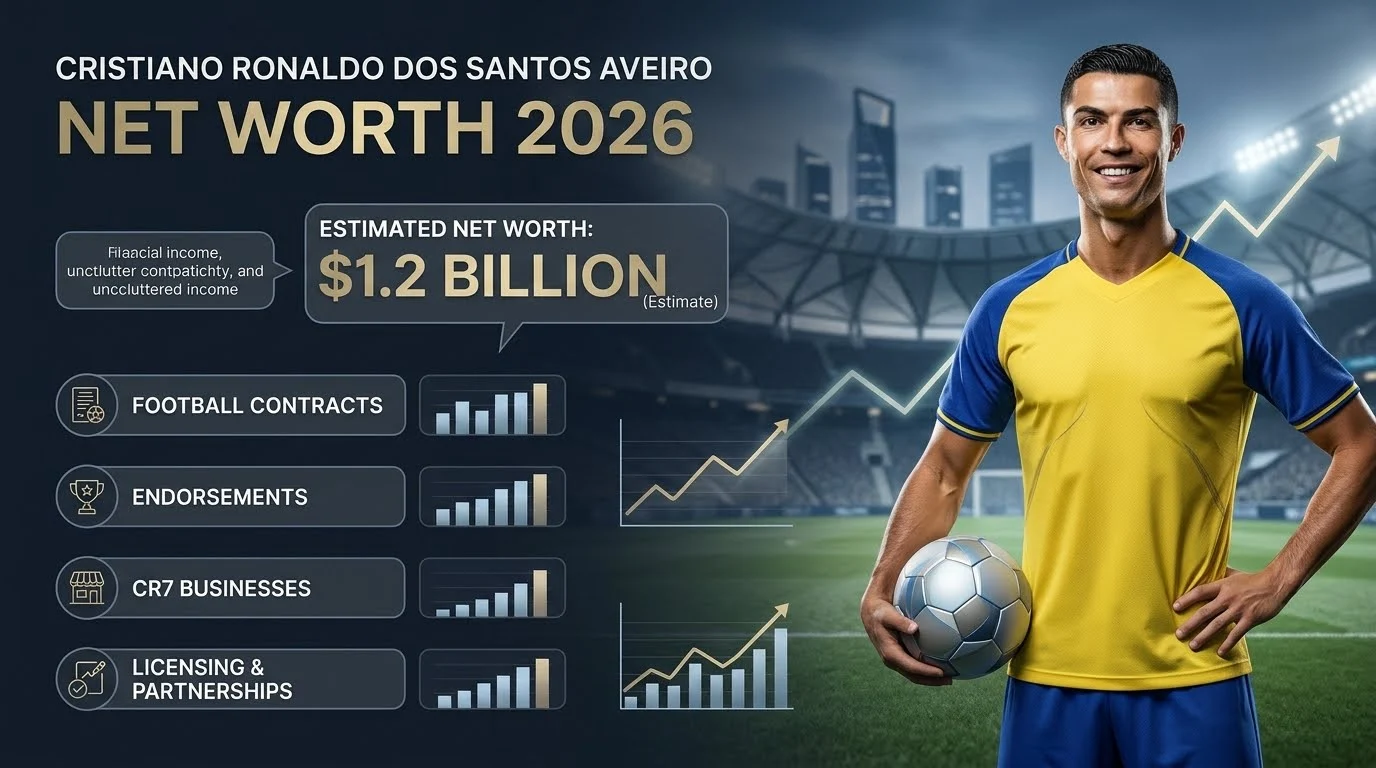
Quick answer: Cristiano Ronaldo dos Santos Aveiro’s net worth is estimated at approximately $1.2 billion in 2026, according to Forbes, reflecting his record-breaking football earnings, lucrative Al-Nassr contract, global endorsements, and business interests; however, his exact personal wealth is not independently established through public financial statements.
Cristiano Ronaldo dos Santos Aveiro has transformed extraordinary football talent into one of the most valuable personal brands in global sports. From his early development in Portugal to his achievements with Manchester United, Real Madrid, Juventus, and Al-Nassr, Ronaldo has built a career that combines elite athletic performance with commercial influence.
In 2026, the question of Cristiano Ronaldo dos Santos Aveiro Networth 2026 has become particularly significant because his earnings now extend well beyond traditional football wages. His Saudi Arabian contract, international sponsorships, CR7-branded businesses, and commercial partnerships have helped him reach a financial position rarely achieved by professional athletes.
Forbes reported in June 2026 that Ronaldo had an estimated net worth of $1.2 billion, making him the first active athlete to enter the billionaire category according to its assessment. Forbes also estimated his total career earnings at approximately $2.1 billion before taxes and agent fees.
These figures require an important distinction. Career earnings measure the money generated over a professional lifetime, whereas net worth represents the value of assets and ownership interests after accounting for liabilities. Neither figure automatically reveals how much cash someone holds or how much could be realized from selling all their investments.
This article examines Ronaldo’s estimated wealth, football income, sponsorships, businesses, assets, financial risks, and long-term earning potential using available reporting and documented career achievements.
Bio Data Table
Cristiano Ronaldo | Biography at a Glance
| Field | Details |
|---|---|
| Full Name | Cristiano Ronaldo dos Santos Aveiro |
| Date of Birth | February 5, 1985 |
| Age in 2026 | 41 |
| Place of Birth | Funchal, Madeira, Portugal |
| Nationality | Portuguese |
| Height | Approximately 1.87 m (6 ft 2 in), as commonly listed in football profiles |
| Weight | Not publicly verified as a consistently current figure |
| Health Conditions | No comprehensive, independently verified public medical profile; Not publicly verified |
| Religion | Not publicly verified for the purposes of this financial profile |
| Education | Attended school in Madeira; complete formal educational qualifications are Not publicly verified |
| Sports / Profession / Industry | Professional football; sports entrepreneurship |
| Zodiac Sign | Aquarius |
| Marriage / Relationship Status | Reported married to Georgina Rodríguez in August 2026; see current biographical reporting. |
| Children | Five living children have been publicly reported; Ronaldo and Rodríguez also experienced the death of a twin son in 2022. |
| Estimated Net Worth | Approximately $1.2 billion, according to Forbes in 2026 |
| Social Media Accounts | Instagram: Cristiano Ronaldo; Facebook: Cristiano Ronaldo; X: Cristiano; YouTube: UR Cristiano |
| Still Alive | Yes |
| Famous For | Football achievements, Portugal national team, five Ballon d’Or awards, global sponsorships, and the CR7 brand |
The biographical details above are separate from the financial estimate. Ronaldo’s reported wealth is not an official declaration of his complete personal assets and liabilities.
Who Is Cristiano Ronaldo? Background and Early Life
Cristiano Ronaldo was born on February 5, 1985, in Funchal, on the Portuguese island of Madeira. He developed an interest in football at an early age and entered organized football through local youth development before joining Sporting CP’s academy in Lisbon.
His move from Madeira to mainland Portugal was an important turning point. Sporting CP provided a more competitive environment and a pathway into senior professional football. His technical ability, speed, finishing, and attacking movement attracted attention from major European clubs.
In 2003, Ronaldo joined Manchester United. Under manager Sir Alex Ferguson, he developed from a talented winger into a more complete attacking player. His performances in England brought trophies, international recognition, and the commercial visibility that would later support his global brand.
His next major step came in 2009, when he joined Real Madrid. The club’s official historical profile records 451 goals in 438 competitive appearances, making him Real Madrid’s all-time leading goalscorer.
Ronaldo subsequently played for Juventus, returned to Manchester United, and moved to Saudi Arabian club Al-Nassr in late 2022. The move to Saudi Arabia significantly increased the scale of his reported playing compensation and strengthened his position as one of the highest-paid athletes in the world.
His career illustrates how an athlete can create several layers of economic value. On-field performance produces salary and bonuses, public recognition attracts sponsors, and a strong personal brand creates opportunities to sell products, license a name, and participate in commercial ventures.
That combination is central to understanding Ronaldo’s 2026 net worth.
Cristiano Ronaldo dos Santos Aveiro Networth 2026: Estimate and Financial Overview

Estimated net worth in 2026
$1.2 billion
Forbes estimate, June 2026
Primary drivers: football compensation, endorsements, and business interests.
Forbes estimated Ronaldo’s net worth at $1.2 billion in June 2026. Its reporting also placed his cumulative career earnings at approximately $2.1 billion before taxes and agent fees. These are different financial measures, and neither should be interpreted as the amount sitting in his bank accounts.
The estimate is supported by several major sources of economic value:
- Football compensation: A highly lucrative Al-Nassr contract and associated performance-related payments.
- Endorsements: Long-running relationships with major brands, including Nike, alongside other commercial partnerships.
- Commercial ventures: The CR7-branded portfolio and associated lifestyle businesses.
- Investments and ownership interests: Business activities that may appreciate independently of his football salary.
However, there is no publicly available, consolidated statement showing every asset, private-company stake, debt, tax obligation, and personal liability held by Ronaldo. The $1.2 billion figure should therefore be treated as a reported estimate, rather than a fully audited personal balance sheet.
Why is Ronaldo’s net worth estimated at $1.2 billion?
The estimate reflects the accumulation of unusually high earnings across a long professional career, combined with commercial opportunities that most footballers cannot access at the same scale.
Forbes reported in June 2026 that Ronaldo had earned approximately $1.4 billion from playing contracts over his career and had generated around $2.1 billion in total career earnings before taxes and agent fees. These figures demonstrate the scale of his income-generating capacity, although the career totals themselves do not determine his net worth.
The difference is important because high earnings are reduced by income taxes where applicable, agent commissions, professional expenses, family expenditure, investment costs, and other financial commitments. In addition, the value of private businesses can rise or fall, while property and other assets may be difficult to sell quickly at their estimated market prices.
The $1.2 billion estimate is consequently best understood as a high-level assessment of accumulated wealth rather than a precise calculation of readily available cash.
Net Worth Growth Timeline
Ronaldo’s financial development followed the progression of his football career. His early earnings came from professional contracts, while later stages introduced larger salaries, global endorsements, and business opportunities.
Before Fame: Youth Development and Sporting CP
Ronaldo’s early years in football were primarily about developing professional ability rather than building a diversified financial portfolio.
At Sporting CP, he began establishing himself as a promising young player. His income during this stage would have been modest relative to the contracts he later secured at Europe’s leading clubs. Detailed historical personal earnings for his youth career are Not publicly verified.
The financial significance of this period was indirect. Strong performances and development created access to a more competitive market, where elite clubs could offer substantially greater compensation.
Financial pattern: Early professional earnings and career development, with limited publicly documented information about personal assets.
Breakthrough Phase: Manchester United and Real Madrid
Ronaldo’s move to Manchester United in 2003 introduced him to a major international football audience. His sporting achievements subsequently improved his bargaining power with clubs and commercial partners.
The 2008 Ballon d’Or and Manchester United’s Champions League success were important career milestones. They reinforced his reputation as one of the leading footballers of his generation and increased his appeal to advertisers.
His transfer to Real Madrid in 2009 marked another major stage. The club’s official records document his extraordinary scoring output, while his performances and trophies established a global profile that extended beyond football supporters.
This period also helped establish the commercial foundations of the Ronaldo brand. His income increasingly reflected a combination of football contracts, performance bonuses, and sponsorship opportunities.
Financial pattern: Contract-based earnings supplemented by performance-related compensation and growing endorsement income.
Peak and Recent Years: Juventus, Manchester United Return, and Al-Nassr
Ronaldo’s move to Juventus in 2018 and return to Manchester United in 2021 continued his high-earning career. His transfer to Al-Nassr in late 2022 then changed the scale of his reported football compensation.
In June 2025, Ronaldo signed a two-year contract extension that keeps him at Al-Nassr through June 2027, according to reporting on the club’s announcement.
Forbes estimated his earnings at $300 million over the 12 months covered by its 2026 highest-paid-athlete ranking. That total comprised approximately $235 million in on-field earnings and $65 million from endorsements, appearances, licensing, memorabilia, and other business activities.
These figures refer to an estimated annual earnings period, not a calendar-year salary statement or a direct increase in net worth.
Financial pattern: Exceptionally high contract income, significant commercial earnings, and business activities capable of generating value beyond his playing career.
Main Sources of Income
Ronaldo’s wealth comes from several related but distinct activities. Understanding each one helps explain why his financial profile is different from that of a footballer who relies exclusively on club wages.
1. Core Profession Income: Football Salary
Football remains the foundation of Ronaldo’s financial success.
His compensation is linked to his playing contract with Al-Nassr, with reported packages that include salary and may also include bonuses or other contractual benefits. The precise breakdown of all compensation components is not fully available through a public, audited statement.
Forbes’ 2026 athlete earnings estimate attributed approximately $235 million to his on-field earnings over the preceding 12 months. This makes football compensation the largest identifiable component of his annual reported earnings.
The distinction between reported contract value and realized personal income matters. A headline contract figure can include different compensation categories and may be quoted before taxes, agent fees, or other expenses. It should not automatically be described as take-home pay.
2. Career Earnings, Bonuses, and Performance Payments
Ronaldo has played for some of the most commercially prominent clubs in world football. His career earnings have accumulated through successive contracts, with compensation shaped by his performance, reputation, market demand, and negotiating position.
Forbes’ 2026 assessment placed his total career earnings at about $2.1 billion before taxes and agent fees. Approximately $1.4 billion was attributed to on-field earnings.
These cumulative figures include money earned over many years. They are not the same as his current annual salary, and they cannot be added to his net worth as though all the money remained in his possession.
Performance bonuses may also depend on contractual terms and sporting outcomes. Specific private bonus schedules should not be assumed unless a reliable report establishes them.
3. Brand Endorsements and Sponsorships
Endorsements are another important part of Ronaldo’s earnings.
His public recognition, audience reach, and association with elite sport make him attractive to companies that want access to international consumers. Commercial partnerships have included Nike and brands identified in Forbes’ reporting, such as Binance, Herbalife, and other consumer-facing businesses.
Nike is particularly significant because the relationship has lasted for many years. Media reports have described a lifetime endorsement arrangement, but the complete private contract terms are not publicly disclosed in an independently audited format. Its reported value should not be treated as an amount paid upfront or as a direct addition to net worth.
In Forbes’ 2026 earnings assessment, approximately $65 million came from endorsements, appearances, licensing, memorabilia, and other off-field business activities combined. That figure does not isolate every sponsor’s payment or represent endorsement income alone.
For a footballer at Ronaldo’s level, commercial earnings can remain significant even as playing time eventually declines. However, sponsorship revenue still depends on contract terms, brand strategy, public reputation, and continuing audience interest.
4. CR7 Merchandise, Licensing, and Product Sales
The CR7 name extends Ronaldo’s identity beyond football. The brand has been associated with fashion, fragrances, underwear, footwear, and other lifestyle products.
These businesses can create revenue through product sales, licensing, distribution partnerships, and collaborations. The precise income attributable to Ronaldo personally depends on the ownership structure and contractual arrangements behind each venture.
A brand’s total sales should not be confused with its owner’s profit. Product businesses incur manufacturing, marketing, distribution, staffing, and other operating costs. Retail partners may also retain a portion of sales revenue.
The strongest financial value of CR7 may therefore come from the combination of consumer recognition, commercial partnerships, and the ability to extend the brand into new categories. Yet the revenue and profitability of every CR7-branded operation are not publicly verified in a consolidated financial statement.
5. Business Investments and Ownership Interests
Ronaldo has also developed commercial interests outside his primary playing contract. These activities may provide diversification and opportunities for wealth creation over time.
His broader commercial portfolio has been associated with hospitality, fitness, and lifestyle ventures. Forbes has specifically described CR7-branded hotels, fitness gyms, and watches among his off-field businesses.
The financial contribution of each business depends on factors such as his ownership percentage, operating profit, financing arrangements, and whether income is distributed or reinvested.
A business may generate substantial revenue while producing relatively little distributable profit. Conversely, a valuable ownership stake may appreciate without producing immediate cash income.
For that reason, Ronaldo’s business portfolio should be evaluated through verified ownership interests and credible company valuations, rather than by adding together the headline revenues of associated brands.
Business Strategy Behind Cristiano Ronaldo’s Wealth
Ronaldo’s financial success reflects a combination of athletic performance, career management, commercial positioning, and the development of a recognizable personal brand.
Reputation and career positioning
Elite performance gave Ronaldo the credibility needed to negotiate lucrative contracts and attract global sponsors. His record at Real Madrid, continued international career with Portugal, and long-term visibility in European and Saudi football strengthened his position in the sports market.
His reputation also helps explain why his earning power has remained unusually high at 41. Although age can reduce a player’s future athletic capacity, commercial recognition may persist beyond the peak years of a sporting career.
Turning attention into commercial value
Ronaldo’s social media presence gives companies access to a large international audience. That reach can support product campaigns, sponsorship agreements, and partnerships that would be difficult for less prominent athletes to secure.
However, follower counts alone do not establish income. The value of an audience depends on engagement, demographics, commercial conversion, and contractual terms.
Developing a brand beyond football
The CR7 brand provides an opportunity to participate in consumer businesses rather than relying exclusively on sporting contracts. This strategy can potentially extend his earning life beyond retirement.
Its effectiveness depends on whether the businesses maintain product quality, consumer demand, sound management, and profitable operations. A famous name can attract customers, but it does not guarantee a profitable enterprise.
Diversification and long-term wealth preservation
Ronaldo’s combination of football income, endorsements, and commercial interests reduces his dependence on any single source of revenue. Diversification can help manage the financial risks associated with retirement or changes in sponsorship demand.
Nevertheless, the exact allocation of his personal portfolio across cash, property, securities, private businesses, and liabilities is Not publicly verified. It would be inappropriate to assign precise percentages without reliable financial disclosures.
Awards and Achievements and Their Financial Impact
Ronaldo’s sporting record is central to his commercial value. His achievements have helped establish the credibility that supports high-value contracts and brand partnerships.
| Achievement | Financial significance |
|---|---|
| Five Ballon d’Or awards | Reinforces his standing as one of football’s most celebrated players and supports long-term brand recognition. |
| Four UEFA Champions League titles | Demonstrates sustained success at the highest level of club football and strengthens his commercial profile. |
| Real Madrid’s all-time leading goalscorer | Provides a lasting historical achievement that supports his legacy and continued public interest. |
| Portugal’s international success | Strengthens his value to sponsors seeking international audiences and national-team visibility. |
| Continued high-level performance in his 40s | Helps sustain media attention and commercial opportunities later in his career. |
The five Ballon d’Or awards and four Champions League titles are recorded in major football coverage, while Real Madrid’s official profile confirms his club scoring record.
Awards do not directly determine net worth. Their economic importance comes from the opportunities they can create: stronger negotiating leverage, sponsorship demand, media interest, and a more durable personal brand.
Assets and Lifestyle
Ronaldo’s estimated wealth is associated with a high-profile lifestyle and business interests, but publicly reported purchases and business affiliations should not be mistaken for a complete asset register.
Real Estate
Ronaldo has been associated in media reporting with luxury residential properties in different locations. However, a reliable estimate of his complete real-estate portfolio would require current ownership records, purchase prices, outstanding mortgages, and market valuations.
Those details are not consolidated in the public information used for this estimate. Accordingly, this article does not assign a specific total value to his real estate.
Property values can also change over time. A reported purchase price may differ considerably from a property’s current market value, and the value of a property does not equal the owner’s equity if borrowing is involved.
Cars and Luxury Purchases
Ronaldo is widely associated with luxury vehicles and premium consumer goods. Nevertheless, individual car values, current ownership, and the value of his complete collection should not be added to his estimated wealth without reliable evidence.
Cars generally depreciate, and insurance, maintenance, storage, and other costs can reduce their financial value over time. High-value consumer assets may signal purchasing power, but they do not necessarily function as productive investments.
Fashion, Investments, and Business Assets
The CR7 brand is a more important part of Ronaldo’s financial story than any unverified luxury inventory. Its commercial interests and partnerships may generate income or create valuable ownership interests.
Other business investments may contribute to his wealth, but their value depends on verified holdings and the financial condition of the underlying companies. Publicly verified information is limited regarding the complete composition of his personal investment portfolio.
Financial takeaway: Ronaldo’s estimated wealth reflects both earning power and the value attributed to assets and commercial interests. His lifestyle alone cannot establish his net worth.
Net Worth Comparison With Peers and the Football Industry
Ronaldo’s financial position stands out even among the world’s highest-paid athletes. Comparisons with other footballers help illustrate how playing contracts, commercial agreements, and ownership interests can produce different wealth outcomes.

Cristiano Ronaldo
$1.2 billion
Forbes estimated net worth, 2026
Forbes estimated total career earnings of approximately $2.1 billion before taxes and agent fees.
$850 million
Celebrity Net Worth estimate, 2026
Celebrity Net Worth published this estimate, while Forbes’ 2026 reporting placed Messi among the highest-paid athletes. The $850 million figure is not a verified balance-sheet value.
These figures suggest that Ronaldo occupies an exceptional position even within elite football. They should not be treated as perfectly comparable financial statements because publishers may use different methods, assumptions, and update schedules.
Forbes’ 2026 all-time athlete earnings assessment placed Ronaldo at approximately $2.1 billion in cumulative career earnings, ahead of Lionel Messi’s reported total of around $1.8 billion. Those figures cover earnings rather than net worth.
Three factors help explain why footballers can have very different financial outcomes:
- Contract size and duration: A long, high-value playing contract can produce much greater gross income than shorter or lower-paying agreements.
- Commercial reach: International sponsors may pay substantial amounts for an athlete whose reputation crosses national and sporting boundaries.
- Business ownership: An athlete who owns a stake in a successful business may build wealth differently from someone whose income comes mainly from salary and sponsorship fees.
The figures for Ronaldo and his peers are estimates. Private investment holdings, debts, family arrangements, and other financial details can materially affect the actual difference between their personal fortunes.
Controversies, Challenges, and Financial Risks
Even a billion-dollar estimated fortune is exposed to financial risks. Ronaldo’s position as a globally recognized athlete creates opportunities, but it also makes the quality of his contracts, reputation, and commercial decisions important to long-term wealth preservation.
Contract and career risk
A substantial portion of Ronaldo’s recent earnings comes from his football contract. His agreement with Al-Nassr runs through June 2027, according to reporting on the extension announced in June 2025.
The end of that contract, a change in sporting performance, or a decision to retire could alter his annual playing income. His commercial value may remain high, but sponsorship and appearance earnings cannot be assumed to replace every dollar of football compensation.
Taxes, fees, and professional expenses
Gross income is not take-home income. Taxes, agents’ fees, legal services, business administration, travel, training, and other expenses can reduce the amount retained.
Ronaldo’s international career also spans different tax and regulatory environments. His precise tax position and personal financial arrangements are not publicly verified in full, so this article does not estimate his annual tax bill.
Sponsorship and reputational risk
A high-profile athlete’s commercial relationships depend partly on public trust. Changes in audience sentiment, sponsor priorities, or contractual expectations can affect the value of partnerships.
A company may also choose not to renew a sponsorship. Diversification helps reduce dependence on individual deals, but it does not eliminate reputational risk.
Business and investment risk
Private businesses can experience declining sales, increased operating costs, or changing consumer demand. Investments may lose value, and ownership stakes can be difficult to sell at a favorable price.
The value attributed to a business interest is therefore not necessarily cash that Ronaldo could access immediately. This uncertainty is especially important when estimating the net worth of a public figure with a diversified commercial portfolio.
These are general financial risks rather than claims that Ronaldo has experienced a particular undisclosed loss or liability.
Philanthropy and Social Impact
Ronaldo’s influence extends beyond professional football. His charitable activities have been reported in connection with medical assistance and humanitarian causes. For example, biographical reporting has described assistance toward medical treatment for children and fundraising related to disaster relief.
Such reporting demonstrates that charitable activity forms part of his public profile. However, individual reports do not provide a complete, independently audited record of all donations, their dates, or their monetary values.
It is therefore not possible to calculate a verified lifetime charitable total from the information cited here.
Ronaldo’s broader social impact also includes his influence on young footballers, his role in popularizing Portuguese football internationally, and his contribution to the commercial visibility of the Saudi Pro League.
These effects are meaningful but should be distinguished from direct financial contributions. Public visibility, sporting representation, and charitable donations are different forms of impact and should not be combined into a single financial measure.
How Cristiano Ronaldo Makes Money Outside Football
Although football remains his principal source of income, Ronaldo has developed commercial activities that could continue generating revenue after his playing career ends.
CR7 lifestyle businesses
The CR7 brand connects his name with consumer products and lifestyle services. Its commercial potential comes from established recognition and the ability to reach consumers who follow Ronaldo for reasons beyond football.
Product sales, licensing arrangements, and business partnerships may contribute to his income. However, the revenue attributable to Ronaldo personally depends on ownership rights, contractual terms, and operating costs.
Hospitality and fitness
Ronaldo has been associated with hospitality and fitness ventures, including CR7-branded hotels and gyms. These businesses offer potential income outside the football transfer market, although their financial performance and his exact economic interests are not fully disclosed publicly.
Hospitality businesses require substantial capital, staff, maintenance, and operating expenditure. Their profitability depends on occupancy, customer demand, location, and management quality. A hotel or gym’s gross revenue should therefore not be confused with Ronaldo’s personal earnings.
Sponsorships, appearances, and licensing
Commercial appearances, licensing agreements, and memorabilia can create additional income. These activities benefit from Ronaldo’s international recognition and the demand for his association with products and events.
Forbes included these categories alongside endorsements and other business activities in its estimated $65 million of off-field earnings for the 12 months covered by its 2026 highest-paid-athlete ranking.
Because several categories are combined in that figure, it would be misleading to assign the full amount to any one business or income stream.
Investments and ownership
Investment returns can arise through dividends, interest, asset appreciation, or proceeds from selling an ownership stake. These are different from wages and sponsorship fees.
Ronaldo’s complete investment portfolio, including the precise value of every holding, is Not publicly verified. His financial profile nevertheless illustrates why business ownership can be important for athletes seeking to preserve and expand wealth beyond their sporting careers.
Future Net Worth Projection
Ronaldo’s financial outlook beyond 2026 depends on the balance between continued earnings, business performance, asset values, and the eventual transition away from professional football.
His Al-Nassr contract runs through June 2027, giving him a documented contractual horizon for his current playing career.
Factors that could increase his wealth
- Continued high-value contracts: Any additional playing agreement or commercial arrangement could extend his earnings at an unusually high level.
- Endorsement demand: Long-standing brand relationships and his global audience may continue to support commercial income.
- Business growth: Profitable expansion of lifestyle, hospitality, or other ventures could increase the value of his ownership interests.
- Investment performance: Appreciation in financial assets, property, or private businesses could contribute to wealth accumulation.
Factors that could limit growth
- Retirement could reduce playing-related earnings.
- Sponsorship values may change as consumer preferences and marketing strategies evolve.
- Private-company valuations and investment returns may fluctuate.
- Taxes, living expenses, business costs, and other liabilities could reduce the amount of wealth retained.
Is Ronaldo likely to become wealthier after retirement?
It is plausible that Ronaldo could continue generating substantial income after football, particularly through endorsements, licensing, and business ownership. However, the size of that income will depend on actual commercial performance rather than reputation alone.
A defensible projection would require information about his future contracts, business valuations, investment holdings, and liabilities. Because those figures are incomplete, assigning a precise future net worth would create false accuracy.
The most responsible conclusion is that Ronaldo has established a substantial financial base, while his post-retirement wealth trajectory remains dependent on business execution, investment outcomes, and spending.
Frequently Asked Questions
What is Cristiano Ronaldo’s net worth in 2026?
Cristiano Ronaldo’s estimated 2026 net worth is $1.2 billion, according to Forbes.
How does Cristiano Ronaldo make his money?
He earns through football contracts, endorsements, sponsorships, licensing, and CR7-branded businesses.
How much does Cristiano Ronaldo earn per year?
Forbes estimated his earnings at $300 million for the 12-month period covered by its 2026 athlete ranking.
What are Cristiano Ronaldo’s career earnings?
Forbes estimated his cumulative career earnings at approximately $2.1 billion before taxes and agent fees.
Is Cristiano Ronaldo a billionaire?
Yes. Forbes estimated his net worth at $1.2 billion in 2026, although the figure is not independently verified through a public personal balance sheet.
Is Cristiano Ronaldo’s net worth officially confirmed?
No. His complete assets, liabilities, and private business interests are not publicly disclosed.
Conclusion
Cristiano Ronaldo’s estimated 2026 net worth is approximately $1.2 billion, according to Forbes. His wealth reflects football earnings, endorsements, and commercial ventures associated with his CR7 brand. Forbes also estimated his cumulative career earnings at $2.1 billion before taxes and agent fees, but career earnings are not the same as net worth. His exact financial position remains unverified because his complete assets and liabilities are not publicly disclosed.
Net worth figures are estimates based on publicly available data and may vary.