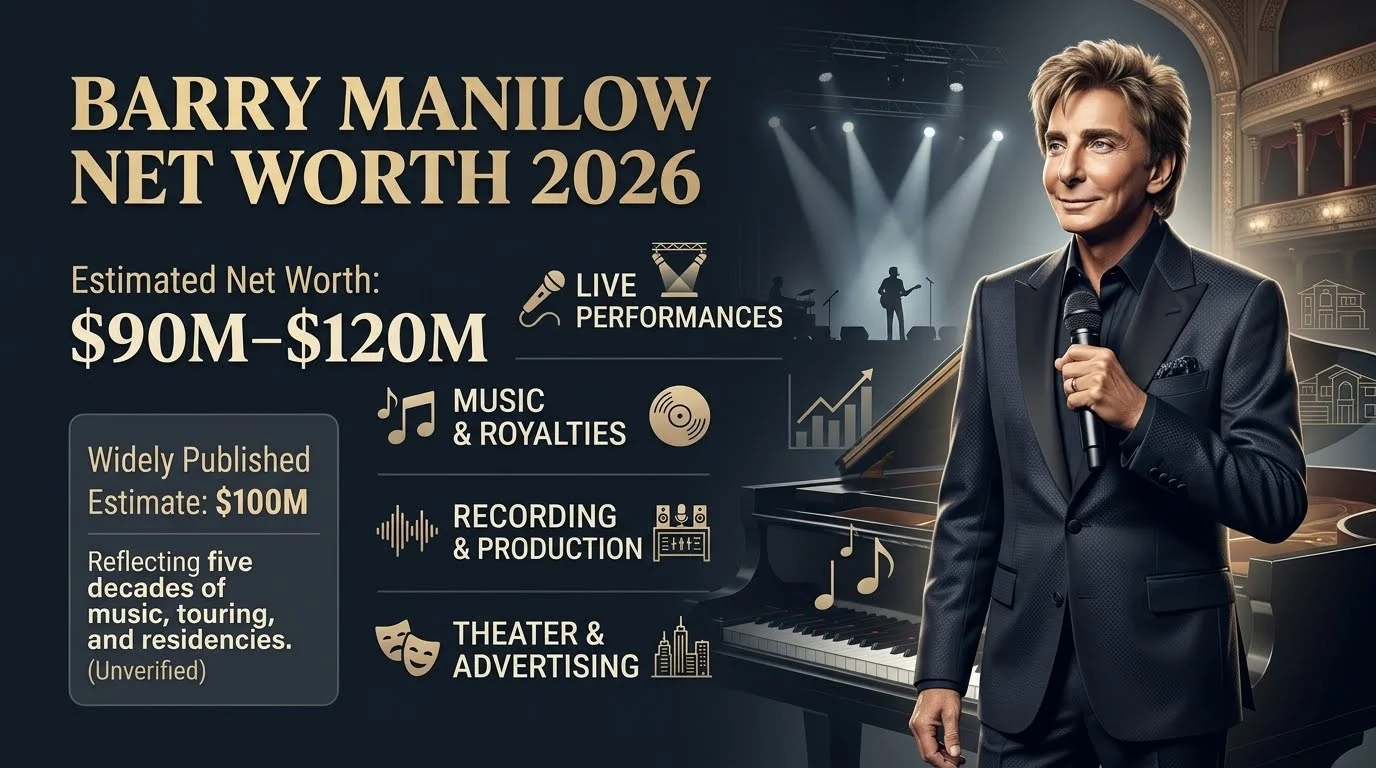
Quick Answer: Barry Manilow’s net worth is estimated at $90 million–$120 million in 2026, with $100 million being the most widely published estimate. His wealth reflects more than five decades of music, songwriting, touring, Las Vegas residencies, production work, and other entertainment projects. However, his complete financial position has not been publicly verified.
Barry Manilow Biography and Personal Details
| Biographical Detail | Information |
|---|---|
| Full Name | Barry Alan Pincus |
| Date of Birth | June 17, 1943 |
| Age in 2026 | 83 |
| Place of Birth | Brooklyn, New York, United States |
| Nationality | American |
| Height | Not publicly verified |
| Weight | Not publicly verified |
| Health | In December 2025, Manilow disclosed that doctors had discovered a stage-one cancerous tumor in his left lung. His official website later reported that his surgery went well. |
| Religion | Not publicly verified |
| Education | His official biography identifies the New York College of Music and the Juilliard School of Music. Specific degree details are not publicly verified. |
| Profession | Singer, songwriter, pianist, arranger, composer, producer, and entertainer |
| Zodiac Sign | Gemini |
| Marital Status | Married to Garry Kief; they married privately in 2014. |
| Children | Information about biological children is not publicly verified in the sources reviewed. |
| Estimated Net Worth | $90 million–$120 million |
| Social Media | Official social profiles are linked through his website; individual account details have not been independently verified here. |
| Living Status | Alive |
| Best Known For | “Mandy,” “Copacabana,” “I Write the Songs,” “Can’t Smile Without You,” “Looks Like We Made It,” and his Las Vegas performances |
GRAMMY’s biography identifies Manilow as a Brooklyn-born artist whose career developed into one of the most enduring in adult contemporary pop. His official biography also documents his early musical education and professional development.
Who Is Barry Manilow? Background and Early Life
Barry Manilow is an American singer, songwriter, pianist, arranger, and producer known for his polished pop arrangements, memorable melodies, and theatrical approach to live entertainment. His career spans more than five decades, with success in recording, songwriting, television, advertising, and stage production.
Born in Brooklyn, New York, in 1943, Manilow developed an interest in music during childhood. According to his official biography, he began taking accordion lessons at age seven and also played a neighbor’s piano. He decided to pursue music professionally while still a teenager.
His early career was far removed from the celebrity lifestyle associated with his later success. While studying music, he worked in the CBS mailroom and developed professional experience in television and advertising. His work composing and arranging commercial jingles helped him build practical skills that would later support his career as a recording artist and producer.
A major turning point came in 1971, when Manilow met Bette Midler. He became her musical director, arranger, and pianist, gaining valuable experience and industry connections. He subsequently secured a recording deal and began releasing solo albums.
His breakthrough arrived with “Mandy,” which became his first No. 1 hit. GRAMMY’s biography also notes that Barry Manilow II became his first album to reach the Billboard 200’s top 10.
Manilow’s success eventually extended beyond performing songs. He established himself as a songwriter, producer, arranger, television performer, theater creator, and Las Vegas headliner.
This range of professional activities is important when assessing Barry Manilow’s net worth in 2026. Rather than relying on a single salary or one successful album, his financial profile reflects several income opportunities developed throughout a long entertainment career.
Barry Manilow Net Worth in 2026: Estimated Wealth
Barry Manilow’s net worth is commonly reported at $100 million in 2026. Celebrity Net Worth listed that estimate in an entry updated June 2, 2026, while Parade has also published a $100 million figure.
Neither estimate represents a publicly available, audited statement of Manilow’s personal finances. His exact wealth therefore cannot be confirmed from these reports alone.
A broader editorial estimate of $90 million–$120 million offers a more cautious way to describe his potential financial position. The range acknowledges that important information about his assets, liabilities, investments, and contractual arrangements remains private.
Several factors make an exact calculation difficult:
- Private investments: His investment holdings and any associated returns are not fully disclosed.
- Music rights: The value of his songwriting, recordings, and publishing interests cannot be calculated reliably without detailed ownership and contract information.
- Touring income: Gross ticket revenue is not the same as the money an artist personally keeps.
- Production expenses: Concerts and residencies involve costs for venues, musicians, crews, transportation, rehearsals, marketing, and management.
- Taxes and personal expenses: These reduce the amount of income ultimately retained.
- Real estate: Property transactions provide evidence of past holdings but do not establish the value of his current portfolio.
- Reinvestment: Some earnings may have been reinvested in entertainment projects or other assets.
For these reasons, $100 million is best described as a widely published estimate rather than a confirmed balance-sheet figure. The $90 million–$120 million range is an editorial estimate intended to communicate uncertainty, not a verified valuation.
One useful historical detail comes from a 2017 Forbes interview. Manilow recalled receiving a $1 million check from Clive Davis following the success of “Mandy.” He described it as his first major career check.
The story illustrates the financial significance of his breakthrough, but it does not establish his current net worth. Even a substantial payment must be considered alongside taxes, expenses, investments, and spending over time.
Career Earnings vs. Net Worth
These financial terms describe different things:
- Gross earnings: Income generated before expenses and deductions.
- Career earnings: Income accumulated through professional activities over time.
- Salary: Compensation paid for a particular job or contractual arrangement.
- Business revenue: Money received by a business before operating expenses.
- Ownership income: Income derived from equity, profit participation, or other ownership interests.
- Royalties: Payments associated with qualifying uses of music or intellectual property.
- Personal net worth: The value of a person’s assets minus their liabilities.
This distinction is particularly important for musicians. A concert can generate substantial revenue without the performer personally receiving the full amount. Production expenses, contractual arrangements, taxes, and other deductions affect the final financial outcome.
Barry Manilow’s Net Worth Growth Timeline
Before Fame
Manilow’s early financial life centered on developing his musical skills and gaining professional experience rather than accumulating celebrity wealth.
His official biography describes his work at CBS while studying music, along with his early involvement in advertising jingles and television. He also worked as an accompanist.
These jobs helped him develop the skills that later became central to his career: composing, arranging, performing, and producing music.
Although his early income is not publicly documented in detail, this period established the professional foundation for his subsequent success.
Breakthrough Phase
Manilow’s career began to accelerate through his work with Bette Midler and his transition into solo recording.
“Mandy” became his first No. 1 hit, helping establish him as a commercially successful recording artist. His early albums and subsequent songs strengthened his position in adult contemporary pop.
The financial impact of this breakthrough was significant. In his Forbes interview, Manilow recalled receiving a $1 million check from Clive Davis after “Mandy” became successful.
Other well-known songs, including “I Write the Songs,” “Looks Like We Made It,” “Can’t Smile Without You,” and “Copacabana,” helped extend his commercial success and establish a recognizable musical catalog.
Peak Career and Recent Years
As Manilow’s career matured, his professional activities expanded beyond album releases. Touring, Las Vegas residencies, television, advertising, theater, and other entertainment projects became additional parts of his career.
His official website reports more than 85 million albums sold worldwide, over 40 albums, 51 Top 40 singles, and 13 No. 1 hits.
His career also remained active in 2026. He released What A Time, his 33rd studio album and first collection consisting mostly of original material in nearly 15 years. His official website also lists arena-tour dates and Las Vegas residency performances.
These activities help explain why Manilow remains commercially relevant after more than five decades in the entertainment industry. His financial profile is supported by both his established body of work and his continuing professional activity.
Barry Manilow’s Main Sources of Income
1. Music, Recording, and Performing
Music is the foundation of Manilow’s wealth.
Barry’s career income has included recording, singing, songwriting, arranging, producing, and performing. His extensive catalog is particularly important because established songs can continue to attract listeners and create commercial opportunities long after their original release.
His 2026 album What A Time demonstrates that his recording career has continued. Meanwhile, his live performances provide additional opportunities to earn income from his musical reputation and established audience.
The exact amount he receives annually from recording, streaming, sales, and related activities is not publicly verified.
2. Touring and Las Vegas Residency
Live entertainment is another important component of Manilow’s financial profile.
His connection with Las Vegas dates back many years. Barry Manilow official biography describes a five-year run beginning in 2005, followed by additional performances on the Las Vegas Strip.
His official website describes the Westgate Las Vegas residency as record-breaking and lists performances in 2026. Announcements published in September 2026 also include additional Las Vegas dates for 2027.
The precise amount Manilow personally earns from his residency has not been publicly disclosed.
Ticket sales and venue revenue should not be treated as personal income. A live show can require substantial spending on musicians, production crews, venue arrangements, transportation, rehearsals, marketing, management, and equipment. The artist’s eventual earnings depend on the relevant contracts and the costs associated with each performance.
A long-running residency can provide a more structured performance schedule than relying exclusively on irregular tours. However, its financial results still depend on attendance, expenses, and contractual arrangements.
3. Songwriting and Music Rights
Songwriting has played an important role in Manilow’s professional career.
Songs such as “Mandy,” “Copacabana,” and “I Write the Songs” remain central to his musical identity. Depending on ownership rights and contractual arrangements, established compositions and recordings can generate income through qualifying uses, including recordings, performances, and licensing.
Manilow’s account of receiving a $1 million check from Clive Davis following the success of “Mandy” also illustrates the financial importance of his breakthrough.
However, the current value of his music catalog and the precise ownership of individual rights are not publicly verified. Assigning a specific value to his catalog without reliable transaction or ownership information would be speculative.
4. Advertising and Commercial Music
Advertising played an important role in Manilow’s early professional development and remains part of his legacy.
His official website says he composed and performed commercial jingles for brands including State Farm, Band-Aid, KFC, Pepsi, and McDonald’s. In 2026, he received the American Advertising Federation’s President’s Award in recognition of his work in commercial music.
Advertising can create opportunities beyond traditional album sales and concert performances. However, the details of Manilow’s individual advertising contracts and any continuing payments associated with those projects are not publicly disclosed.
5. Theater and Production
Manilow has also worked on projects outside conventional pop recording.
His musical Harmony, created with Bruce Sussman, reached Broadway in 2023. Broadway production materials identify the show as being produced in association with Stiletto Entertainment.
Theater projects can provide creative opportunities, but their financial outcomes are uncertain. Capitalization, production costs, theater expenses, ticket sales, and other contractual arrangements all influence profitability.
Consequently, Harmony is best viewed as part of Manilow’s broader entertainment portfolio rather than as a guaranteed source of personal profit. The amount he personally earned from the production is not publicly verified.
The Business Strategy Behind Barry Manilow’s Wealth
Manilow’s financial profile reflects the value of a long-lasting career and a diversified set of entertainment activities. Rather than depending entirely on one type of income, he has worked across recording, songwriting, live performance, television, advertising, and theater.
A Recognizable Professional Reputation
A distinctive musical identity can remain commercially valuable for decades.
Manilow’s recognizable songs continue to form a central part of his public profile. Established music can create opportunities for performances, licensing, streaming, and purchases long after its initial release.
The precise financial value of these opportunities depends on ownership rights, audience demand, and contractual terms.
Audience Loyalty
Manilow has developed a recognizable musical style and a dedicated audience over the course of his career.
An established audience can support concert attendance, Las Vegas performances, catalog consumption, and interest in new releases. This provides a continuing commercial foundation even when an artist’s career differs from the chart-driven model of a newer performer.
Audience loyalty does not guarantee a specific income level, but it can help sustain demand for live performances and recorded music.
A Repeatable Live-Performance Model
Las Vegas has given Manilow a recurring live-entertainment platform.
A residency can provide a more predictable performance structure than relying exclusively on tours that move between cities. It may also allow an artist to work with established production arrangements and reach audiences who travel to see the show.
The financial outcome still depends on attendance, expenses, venue agreements, and the artist’s contract.
Intellectual Property and Creative Work
Manilow’s professional legacy includes songs, recordings, performances, and theatrical projects. These forms of creative work can have continuing commercial value.
For an artist with more than five decades in entertainment, intellectual property may be an important part of the overall financial picture. However, the specific value of Manilow’s rights and related interests remains undisclosed.
Awards and Achievements: Financial Impact
Manilow’s awards and career milestones help demonstrate the longevity of his professional reputation.
GRAMMY records list one win and 15 nominations, including his 1979 award for Best Pop Vocal Performance, Male, for “Copacabana (At the Copa).”
He is also a Tony, Emmy, and GRAMMY winner and an inductee of the Songwriters Hall of Fame. His official website identifies him as a recipient of the BMI Icon Award.
In 2026, Manilow received the American Advertising Federation’s President’s Award in recognition of his contributions to commercial music.
Awards do not automatically increase a person’s net worth. Their potential financial value is indirect: professional recognition may strengthen an artist’s reputation, support audience demand, create new opportunities, and help sustain the commercial life of a musical catalog.
Manilow’s achievements therefore provide useful context for his long-term earning potential, but they do not independently establish his current wealth.
Barry Manilow’s Assets and Lifestyle
Real Estate Holdings
Real estate provides some of the clearest publicly reported examples of Manilow’s historical assets.
In 2021, Realtor.com reported that Pink and Carey Hart purchased a Malibu beachfront property formerly owned by Manilow for $13.7 million.
A separate Realtor.com report documented that Manilow had purchased a Malibu property in 2003 and sold it in 2012 for approximately $5.5 million.
These transactions demonstrate that he has owned valuable property. They do not establish that he still owns either property or reveal the full extent of his current real estate holdings.
His present property portfolio and its total value are not publicly verified in full.
Cars and Luxury Possessions
Reliable details about Manilow’s current vehicle collection are not publicly verified.
Celebrity wealth articles sometimes make unsupported claims about expensive cars, watches, jewelry, and other possessions. Without credible documentation, assigning values to these items would create a misleading picture of his finances.
Investments and Business Assets
Manilow’s professional assets may be more financially significant than consumer luxury goods.
His broader career includes music-related intellectual property, professional relationships, live-show arrangements, and a recognizable entertainment brand. These may contribute to his commercial opportunities, although their individual values are not publicly available.
The value of his private investments, business interests, and any ownership stakes is not publicly verified.
Barry Manilow Net Worth Compared With Other Musicians
Comparing Manilow with other established musicians illustrates the limitations of published celebrity net worth estimates.
Celebrity Net Worth estimates Elton John’s wealth at $650 million and Neil Diamond’s at $300 million, compared with its $100 million estimate for Manilow. These figures are third-party estimates rather than audited personal financial statements.
Differences between the figures may reflect several factors, including career earnings, publishing arrangements, music-rights transactions, touring activity, investments, expenses, and personal financial decisions.
Elton John’s reported estimate is associated with a substantial international recording career, publishing economics, and major touring activity. Neil Diamond’s reported wealth has also been discussed in connection with the sale of his song catalog and recording rights.
Manilow’s career has placed particular emphasis on adult contemporary pop, songwriting, Las Vegas performances, theatrical projects, and long-term audience engagement.
These comparisons offer context, but they do not establish the accuracy of any individual estimate. Different sources may use different assumptions, and the private financial details needed to confirm these figures are generally unavailable.
Financial Challenges and Risks
Manilow’s financial risks are largely connected to the music and live-entertainment industries. Even a successful performer faces costs, changing audience habits, and uncertainty around future projects.
Touring and Production Costs
Concerts can generate substantial gross revenue, but that amount does not equal an artist’s personal profit.
Live performances may require spending on musicians, production teams, transportation, venues, equipment, insurance, marketing, and other operating costs. The performer’s share depends on contractual terms and the financial structure of the event.
Changes in the Music Industry
The economics of music have changed considerably since Manilow began his career.
Physical album sales, digital purchases, streaming, and licensing operate under different commercial models. An artist’s income from recorded music can therefore change as audience behavior and distribution arrangements evolve.
Manilow’s established catalog and continued live performances offer different sources of commercial activity, but the exact contribution of each source to his income is not publicly disclosed.
Health-Related Career Disruption
In December 2025, Manilow announced that doctors had discovered a stage-one cancerous tumor on his left lung. His official website later reported that he underwent surgery and that the operation went well. His 2026 schedule was adjusted before he returned to public performances.
This development is relevant to a financial assessment only in the limited sense that an extended interruption to live performances could affect performance-related income.
It would be inappropriate to speculate about his future health or ability to work beyond his documented public statements and announced schedule.
Theater and Project Risk
Musical theater projects, including Harmony, can require substantial upfront investment and may produce uncertain financial returns.
Production costs, ticket sales, theater expenses, and contractual arrangements influence a show’s financial performance. Although production materials document Harmony’s Broadway run and its association with Stiletto Entertainment, Manilow’s personal financial outcome from the production is not publicly verified.
Philanthropy and Social Impact
Philanthropy is an established part of Manilow’s public career.
The Manilow Music Project supports music education by providing instruments and resources to public schools. According to his official website, the initiative has invested millions of dollars in music education.
In 2026, the project continued its teacher-recognition program, with educators in several cities receiving $10,000 grants to support teachers and school music programs.
Manilow has also discussed his personal contributions to the project. In a 2017 Forbes interview, he said he had personally contributed more than $100,000 at that time.
These charitable activities are part of his public legacy, although donations and fundraising totals should not be treated as direct evidence of his personal net worth.
How Barry Manilow Earns Money Beyond Recording Music
Although music remains at the center of Manilow’s career, his professional activities have extended into several related areas.
Commercial Music and Advertising
Manilow’s advertising work includes commercial jingles for major consumer brands. This experience helped broaden his career beyond conventional recording and performing.
The exact value of his advertising contracts and any continuing payments is not publicly disclosed.
Theater
His work on Harmony demonstrates his involvement in musical theater as a composer and creative collaborator.
Theater can create additional professional opportunities, but the profitability of any individual production depends on its costs, ticket sales, and contractual arrangements.
Television and Media
Manilow has participated in television specials and other filmed entertainment throughout his career. His official biography documents Emmy-recognized television work and related media projects.
The specific amount of income generated by these projects is not publicly verified.
Music Catalog and Licensing
His songwriting and recording history may generate continuing royalties and licensing opportunities, depending on the ownership rights and agreements governing each work.
However, the percentages of rights he currently owns and the amount he receives annually from these sources are not publicly verified.
Live Appearances
Las Vegas residency performances and arena shows remain active parts of Manilow’s professional calendar in 2026.
These performances provide opportunities to earn live-entertainment income, although his personal earnings after expenses and contractual deductions have not been publicly disclosed.
Barry Manilow Net Worth Projection
Barry Manilow’s future financial position will depend on how his income, expenses, assets, and liabilities change over time. His ongoing performances and 2026 recording activity provide evidence that his entertainment career remains active.
Several factors could influence his future wealth:
- Continued Las Vegas residency performances
- Arena tours and other live appearances
- Income associated with his music catalog
- New recording projects
- Licensing and commercial use of existing work
- Theater and other entertainment projects
- Changes in real estate values
- The performance of private investments
- Taxes, management fees, production costs, and personal expenses
The announcement of additional 2027 Las Vegas dates in September 2026 indicates that his residency remains part of his professional plans. His 2026 release of What A Time also demonstrates continued recording activity.
If his live performances, music-related income, and other entertainment activities continue to generate more cash than his expenses and personal outflows, his wealth could remain relatively stable or increase gradually.
However, this is a conditional assessment rather than a guaranteed forecast. A precise future net worth figure would be speculative because his complete financial information is not publicly available.
Frequently Asked Questions
What Is Barry Manilow’s Net Worth in 2026?
Barry Manilow’s estimated 2026 net worth is $100 million, though his actual wealth is unverified.
How Does Barry Manilow Make His Money?
He earns through music sales, songwriting, concerts, Las Vegas residencies, production, and theater.
How Much Did Barry Manilow Make From “Mandy”?
Manilow recalled receiving a $1 million check from Clive Davis after “Mandy” became successful.
Is Barry Manilow Still Performing in 2026?
Yes. He continues to perform through scheduled concerts and Las Vegas shows.
Does Barry Manilow Own Valuable Real Estate?
He has owned valuable properties, including a Malibu home reportedly sold for $13.7 million in 2021.
Is Barry Manilow’s $100 Million Net Worth Confirmed?
No. The figure is a published estimate, not an audited valuation of his assets and liabilities.
Conclusion
Barry Manilow’s estimated 2026 net worth is $90 million–$120 million, with $100 million the most widely published figure. His wealth reflects decades of songwriting, recording, concerts, Las Vegas residencies, and production work. Although his music catalog and continued performances provide ongoing income opportunities, his complete assets, investments, and liabilities remain private, making his exact net worth impossible to verify.
Net worth figures are estimates based on publicly available data and may vary.