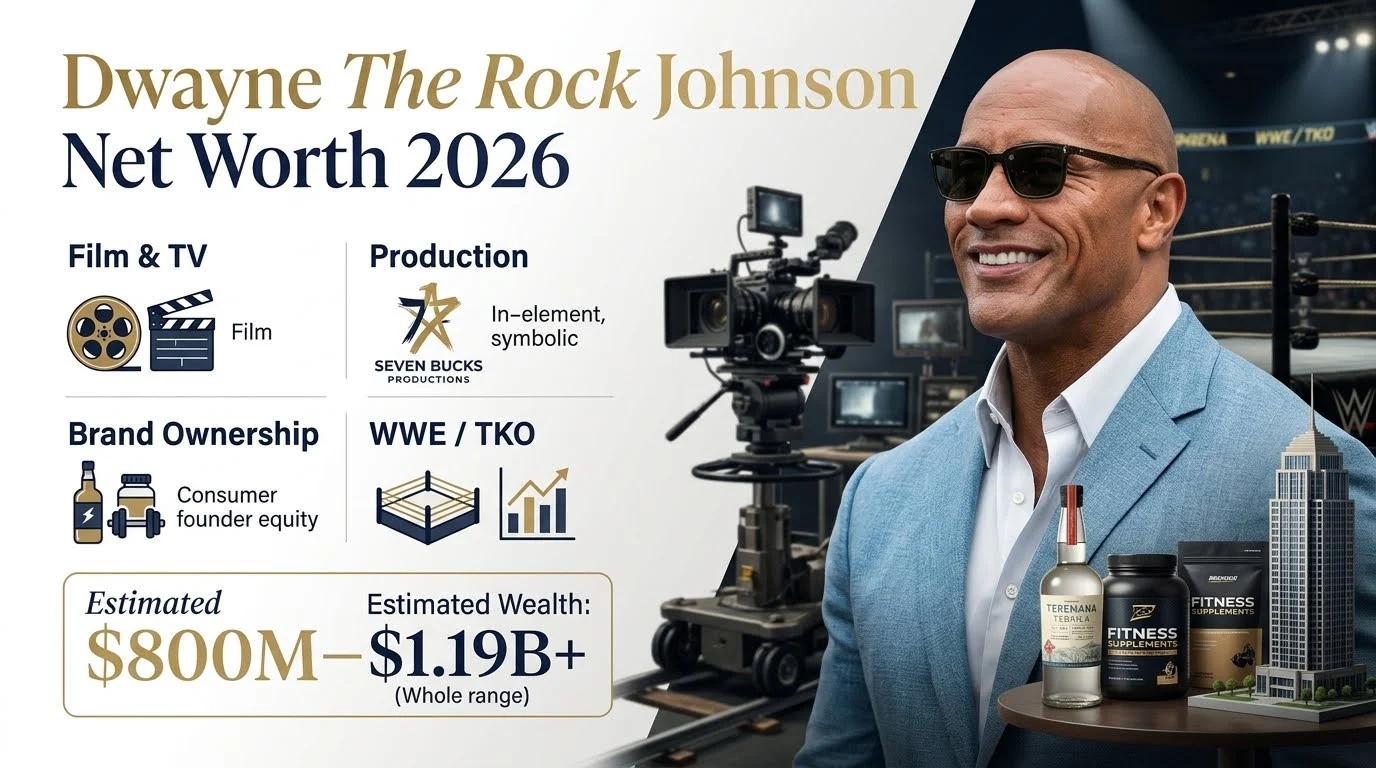
Quick answer: Dwayne “The Rock” Johnson’s estimated 2026 net worth ranges from $800 million to over $1.19 billion, depending on how his entertainment earnings, private-company stakes, and business interests are valued. The $800 million estimate is more commonly reported, while figures exceeding $1.19 billion rely on additional assumptions. Neither figure is publicly verified.
Dwayne Johnson has transformed his success as a professional wrestler into a global entertainment and business career. His wealth comes from Hollywood film salaries, production through Seven Bucks Productions, his stake in Teremana Tequila, WWE and TKO-related compensation, commercial partnerships, and sports ventures.
Unlike entertainers who primarily depend on acting salaries, Johnson has built a portfolio that includes business ownership, intellectual-property licensing, and corporate relationships. These interests can potentially generate value beyond his earnings from individual films.
Net worth figures are estimates based on publicly available data and may vary.
Dwayne Johnson Bio Data Table
| Field | Details |
|---|---|
| Full name | Dwayne Douglas Johnson |
| Professional name | Dwayne “The Rock” Johnson |
| Date of birth | May 2, 1972 |
| Age in 2026 | 54 |
| Place of birth | Hayward, California, United States |
| Nationality | American |
| Height | 6 ft 5 in (1.96 m), according to WWE |
| Weight | Approximately 260 lb (118 kg), according to WWE |
| Health conditions | Not publicly verified |
| Religion | Not publicly verified |
| Education | University of Miami |
| Profession | Actor, producer, entrepreneur, professional wrestler |
| Zodiac sign | Taurus |
| Marital status | Married to Lauren Hashian |
| Children | Three daughters |
| Estimated net worth in 2026 | Approximately $800 million to over $1.19 billion, depending on valuation assumptions |
| @therock | |
| Status | Living |
| Famous for | WWE, Hollywood films, Seven Bucks Productions, Teremana Tequila, and other business ventures |
Who Is Dwayne “The Rock” Johnson?
Dwayne Douglas Johnson is an American actor, producer, entrepreneur, and former professional football player who became internationally famous as WWE wrestler The Rock. His career is notable for the transition from professional wrestling to Hollywood and, later, to business ownership.
Born on May 2, 1972, in Hayward, California, Johnson grew up in a family connected to professional wrestling. His father, Rocky Johnson, was a professional wrestler, and his maternal grandfather, Peter Maivia, also had a prominent place in the wrestling world.
Before becoming a household name, Johnson pursued American football. He attended the University of Miami on a football scholarship and played for the Miami Hurricanes. After college, he briefly pursued professional football with the Canadian Football League before turning to wrestling.
His WWE career began in 1996 as Rocky Maivia. The character eventually evolved into The Rock, whose charisma, catchphrases, and performances made him one of the most recognizable personalities in professional wrestling.
Johnson’s success in WWE created the platform for his move into film. He appeared in productions such as The Mummy Returns and The Scorpion King before becoming a major Hollywood star through franchises and films including Fast & Furious, Jumanji, Moana, Jungle Cruise, Black Adam, and Red Notice.
Over time, he expanded beyond performing. Through Seven Bucks Productions and consumer-brand investments, Johnson began participating in the business side of entertainment and product development.
This combination of celebrity, production ownership, commercial partnerships, and equity interests is central to understanding his estimated wealth.
Dwayne The Rock Johnson Net Worth in 2026
Dwayne Johnson’s 2026 net worth is the subject of varying public estimates. A frequently reported figure is approximately $800 million, while some claims place his potential wealth above $1.19 billion.
These figures should not be treated as equally established. The $800 million estimate appears in entertainment and celebrity-finance coverage, including reporting that cites celebrity-net-worth trackers. The higher figure depends more heavily on assumptions about the value of Johnson’s private businesses and ownership stakes.
There is no publicly available, independently audited statement that confirms his exact personal net worth.
Why Do Estimates Range From $800 Million to More Than $1.19 Billion?
Johnson’s wealth includes more than money earned from acting. His financial interests span several categories:
- Hollywood film and television compensation
- Production and development through Seven Bucks Productions
- Co-ownership of Teremana Tequila
- WWE-related services and intellectual-property arrangements
- Equity compensation connected with TKO Group Holdings
- Consumer-brand partnerships
- Sports ventures, including the United Football League
- Endorsements and commercial appearances
- Real estate and other personal assets
Some of these interests generate income directly, while others may increase in value over time. Private businesses, in particular, can be difficult to value because they do not have continuously published market prices.
A higher estimate may assign substantial value to Johnson’s business stakes. However, a company’s overall valuation cannot simply be counted as the owner’s personal wealth. The value of an ownership interest depends on the percentage held, the company’s financial position, liabilities, contractual arrangements, and the terms under which the stake could be sold.
For this reason, the $800 million figure is a useful commonly reported reference point, while estimates above $1.19 billion should be regarded as higher-end claims requiring further valuation evidence.
Net Worth Is Not the Same as Career Earnings
Johnson has reportedly received very large payments for major film roles, but those payments cannot be added together and treated as his current net worth.
Career earnings represent income generated over time. Net worth is the value of assets minus liabilities at a particular point in time.
The distinction matters because an actor’s gross compensation can be reduced by taxes, representation fees, legal expenses, management costs, and other obligations. Business revenue must also cover operating expenses before it becomes profit or distributable income.
Similarly, restricted stock units and private-company equity may have substantial potential value without being equivalent to cash that can immediately be spent.
Dwayne Johnson’s Net Worth Growth Timeline
Before Fame: Football and Family Wrestling Connections
Johnson’s early ambitions centered on football. His athletic career at the University of Miami offered a possible route into professional sports, but that path did not become his long-term profession.
After his football opportunity ended, he entered professional wrestling. His family’s history in the sport gave him an introduction to the industry, although his eventual success depended on developing his own persona and audience.
At this stage, his professional income was primarily connected to sports and entertainment work rather than the diversified business portfolio he later developed.
Breakthrough: Becoming The Rock
Johnson’s rise in WWE was the first major stage of his financial transformation.
His early Rocky Maivia character eventually evolved into The Rock, a personality that connected with wrestling audiences through performance, humor, and memorable promotional appearances. His championship achievements and 2000 Royal Rumble victory strengthened his place in WWE history.
The Rock brand eventually became valuable beyond wrestling. It created an identity that audiences recognized across television, live events, merchandise, and other forms of entertainment.
That recognition helped Johnson make the transition into film, where he developed a second major source of income.
Hollywood Growth: Building a Film Career
Johnson’s film career expanded through projects including The Scorpion King, the Fast & Furious franchise, Jumanji, Moana, Jungle Cruise, and Red Notice.
As his popularity increased, he gained access to higher-profile productions and large compensation packages. For select blockbuster projects, entertainment reporting has described payments reaching tens of millions of dollars.
However, individual contract terms vary. Some arrangements may include acting fees, buyouts, producer compensation, or profit participation, while others use different structures.
Johnson’s move into producing was especially important because it offered a route to participate in projects beyond his role as an actor.
Recent Years: Business Ownership and Corporate Interests
Johnson’s recent wealth strategy has centered on combining entertainment with business ownership.
Seven Bucks Productions provides a platform for film and television development. Teremana extends his personal brand into consumer products. His WWE and TKO relationships involve services, intellectual-property arrangements, and equity compensation.
His business interests also extend into sports and energy drinks, including the United Football League and ZOA Energy.
This diversified portfolio makes estimating his wealth more complicated. Film earnings can be researched through industry reporting, but the value of private businesses and individual ownership stakes is not always publicly disclosed.
Main Sources of Dwayne Johnson’s Income
1. Hollywood Film Salaries
Acting is one of Johnson’s most visible sources of income.
He has appeared in major studio productions, franchises, and streaming films. His commercial appeal can help him negotiate substantial compensation, particularly for leading roles in large-budget projects.
Industry reports have described film packages worth $20 million or more for some major roles. A widely cited example is Red Notice, for which reporting has placed his compensation package at approximately $50 million, including a fee and buyout arrangement.
Such figures should be understood as reported contract estimates, not audited disclosures. The terms of individual film deals are generally private, and the structure of compensation can differ from one production to another.
Johnson’s film income may include:
- Upfront acting fees
- Producer fees
- Buyouts or other contractual payments
- Profit participation, where negotiated
- Compensation connected with promotional commitments
These categories should not be assumed to apply to every film. The actual terms depend on the contract.
2. Seven Bucks Productions
Seven Bucks Productions is one of Johnson’s most important business ventures. He co-founded the company with Dany Garcia, and it has been involved in films, television, and other entertainment projects.
Its portfolio includes productions associated with Jumanji, Red Notice, Black Adam, Hobbs & Shaw, Young Rock, The Titan Games, and Moana.
Production ownership can create financial opportunities beyond acting salaries. Producers may participate in development, packaging, financing arrangements, production fees, and other contractual aspects of a project.
However, a production company’s project list does not reveal its annual profit or the personal value of a founder’s stake. Those figures depend on business expenses, financing, ownership arrangements, and the performance of individual projects.
3. Teremana Tequila
Teremana Tequila is a major consumer-brand venture associated with Johnson.
Rather than serving only as a paid spokesperson for an existing tequila brand, Johnson became a co-owner and a central part of Teremana’s identity. The brand markets tequila produced in Jalisco, Mexico, and has highlighted traditional production methods.
Teremana’s reported growth has attracted attention from business and financial publications. Rapid expansion can increase the potential value of a consumer brand, particularly if it develops a strong distribution network and sustained customer demand.
Nevertheless, Teremana is privately held, and the exact value of Johnson’s ownership stake is not publicly confirmed.
Its contribution to his net worth therefore depends on assumptions about the company’s value, the percentage he owns, and any relevant financial obligations or contractual arrangements.
4. WWE and TKO Group Holdings
Professional wrestling remains an important part of Johnson’s business identity even though his career expanded well beyond the ring.
In 2024, Johnson entered into a services agreement with WWE. Public corporate filings also disclosed a grant of $30 million in TKO restricted stock units associated with the arrangement.
Restricted stock units are equity-based compensation rather than an ordinary cash salary. Their value can depend on market prices, vesting requirements, and other conditions.
The WWE arrangement also involved intellectual-property rights associated with The Rock name. Johnson’s relationship with WWE therefore includes commercial arrangements that extend beyond compensation for individual appearances.
These agreements demonstrate how a performer can continue to monetize a well-known persona through licensing, services, and equity-related compensation.
However, restricted stock units should not simply be added to net worth at their headline value without considering vesting, market fluctuations, and other conditions.
5. ZOA Energy and Project Rock
Johnson has also expanded his commercial presence into fitness and consumer products.
ZOA Energy is an energy-drink brand associated with Johnson and his business partners. Project Rock is his fitness and performance-oriented product line developed in partnership with Under Armour.
These ventures connect his public identity with fitness, training, and an active lifestyle. They also offer ways to monetize audience recognition outside movies and wrestling.
The financial contribution of each brand depends on its sales, operating expenses, contractual arrangements, and Johnson’s ownership or compensation structure.
Public association with a product does not automatically mean the individual owns the entire business. The specific structure of a partnership must be considered before estimating its value.
6. United Football League and Sports Ventures
Johnson is associated with the ownership group behind the United Football League (UFL), a professional spring football league.
Sports ownership can offer potential value through media rights, sponsorships, ticket sales, merchandise, and league development. However, a sports venture’s revenue is not the same as its owner’s personal income.
League operations can also involve substantial expenses, including player compensation, stadium arrangements, production, travel, marketing, and administration.
The UFL’s contribution to Johnson’s net worth cannot be precisely established without detailed information about ownership percentages, the league’s finances, and the terms of the investment.
7. Brand Endorsements and Commercial Partnerships
Johnson’s global recognition makes him a valuable figure for commercial campaigns.
His public identity combines professional wrestling, Hollywood, fitness, entrepreneurship, and family-oriented entertainment. This broad appeal can create opportunities for endorsements and promotional partnerships.
However, not every appearance or product association is a paid endorsement, and the value of individual agreements is not always public.
It is therefore more accurate to recognize endorsements as a potential income category than to assign Johnson an unsupported annual total.
8. Real Estate and Other Investments
Real estate and other assets may contribute to Johnson’s personal wealth.
His property purchases have received media attention, including a reported Beverly Park estate purchase in 2021 for more than $27.8 million.
A purchase price, however, is not necessarily the property’s current market value. Mortgage obligations, taxes, upkeep, improvements, and changes in the housing market all affect its financial position.
The same principle applies to other investments: the value of an asset must be assessed alongside relevant liabilities and costs.
Business Strategy Behind The Rock’s Wealth
Johnson’s financial strategy can be understood through four connected principles: brand leverage, ownership, diversification, and intellectual-property value.
Brand Leverage
The Rock began as a wrestling persona but developed into a recognizable global entertainment brand. That recognition can help promote films, products, and business ventures.
His audience reach gives companies a way to connect entertainment with consumer products. However, commercial success still depends on product quality, distribution, competition, and consumer demand.
Ownership Rather Than Endorsement Alone
A major difference between a traditional celebrity endorsement and business ownership is the way the individual participates in the venture’s financial performance.
A spokesperson may receive a contracted fee. An owner may benefit from profits or an increase in the value of the business, while also facing the risks of business expenses and losses.
Teremana illustrates this distinction. Johnson’s connection to the brand goes beyond simply appearing in an advertisement, although the precise value of his stake is not publicly established.
Diversification Across Industries
Johnson’s business interests span entertainment, consumer products, fitness, sports, and intellectual property.
Diversification can reduce reliance on a single source of income. If one film underperforms, other businesses may continue operating. Conversely, a successful production can increase interest in related products or future projects.
Diversification does not eliminate risk, however. Businesses can face declining sales, rising costs, competition, or changes in consumer behavior.
Intellectual-Property Monetization
The Rock name has commercial value because audiences recognize it across different industries.
Johnson’s WWE-related arrangements illustrate how intellectual-property rights can be licensed and used commercially. Similar principles apply to entertainment franchises and production-related rights.
The precise financial value depends on the rights involved, contract terms, and commercial demand.
Awards, Achievements, and Financial Impact
Johnson’s career achievements have strengthened his visibility in both wrestling and entertainment.
His WWE career includes multiple world championship reigns and the 2000 Royal Rumble victory. He also developed a successful film career and received industry recognition for his television and entertainment work.
His honors have included People’s Choice Awards for his work on Ballers, an NAACP Image Award for Entertainer of the Year, and a star on the Hollywood Walk of Fame in 2017.
These achievements can support a performer’s marketability, but they do not establish a specific monetary value.
The more direct financial indicators are Johnson’s reported film compensation, business ownership, production activity, and publicly disclosed corporate arrangements.
Assets and Lifestyle
Real Estate
Johnson has owned high-value residential properties. Architectural Digest reported that he purchased a Beverly Park estate in 2021 for more than $27.8 million.
The property was reported to include extensive grounds and amenities. Nevertheless, the purchase price should not be interpreted as its current value or as a direct addition to his net worth without accounting for financing and other obligations.
A property is an asset, but its net contribution to wealth depends on ownership structure, debt, maintenance costs, and market conditions.
Cars and Luxury Purchases
Johnson’s public image frequently features luxury vehicles, travel, and high-end lifestyle content.
However, photographs and social-media posts are not sufficient evidence of ownership. Some vehicles may be borrowed, rented, supplied for promotional purposes, or owned by a business.
Without reliable confirmation of ownership and valuation, a precise value for his personal car collection should not be included in a net-worth calculation.
Business Assets and Equity
Johnson’s business interests may be more financially significant than individual luxury purchases.
Seven Bucks Productions, Teremana, his consumer-brand ventures, and TKO-related equity represent potential sources of business value. Their actual contribution depends on ownership percentages, business performance, liabilities, and the terms of the relevant agreements.
Net Worth Comparison With Other Hollywood Entrepreneurs
Johnson’s financial model shares features with other Hollywood stars who have developed businesses alongside their entertainment careers, including Ryan Reynolds and Kevin Hart.
These comparisons are most useful when they focus on business structure rather than an exact ranking of personal wealth.
Johnson combines:
- Professional wrestling and WWE-related brand value
- Hollywood acting and production
- Consumer-product ownership
- Brand partnerships
- Intellectual-property licensing
- Corporate equity compensation
- Sports-related business interests
Annual earnings should not be confused with net worth. An actor can earn tens of millions of dollars in one year without adding the same amount to personal wealth.
Likewise, a business owner’s wealth may rise because an ownership stake becomes more valuable, even when the owner does not receive an equivalent amount in cash.
Because complete personal financial statements are not available for most entertainers, exact celebrity wealth rankings remain uncertain.
Financial Risks and Challenges
Despite his commercial success, Johnson’s wealth is exposed to several risks.
Film Performance Risk
Large film salaries do not guarantee that a movie will be commercially successful. A production’s box-office performance, streaming economics, and marketing costs affect the studio’s overall results.
An actor’s compensation may be contractually secured even when a film underperforms, but repeated commercial disappointments can affect future opportunities and negotiating leverage.
Private-Company Valuation Risk
Teremana and other privately held ventures are difficult to value without detailed financial disclosures.
A headline business valuation does not necessarily represent the price an owner could receive for their stake. Ownership restrictions, liabilities, future growth assumptions, and the terms of a potential sale can materially affect value.
Operating Costs
Consumer brands and sports ventures require spending on manufacturing, distribution, staffing, marketing, logistics, and compliance.
Revenue does not equal profit, and profit does not automatically equal the owner’s personal income.
Taxes and Professional Fees
Johnson’s entertainment and business income may be subject to taxes, legal expenses, accounting costs, management fees, and other obligations.
These costs are important when translating gross earnings into retained wealth.
Dependence on a Personal Brand
Johnson’s businesses benefit from his public image, but that connection can also create risk. A major reputational issue could affect multiple commercial relationships at once.
A diversified portfolio can reduce dependence on one industry, but it does not eliminate risks that are shared across businesses linked to the same public figure.
Philanthropy and Social Impact
Johnson has been associated with charitable initiatives and community-oriented activities, including support for children, military communities, and disaster-related efforts.
His public recognition has also included acknowledgment of philanthropic activity. However, the amounts and timing of individual contributions are not consistently documented in a way that supports a precise annual total.
Charitable giving should be distinguished from business spending, brand campaigns, or public appearances. Without independently documented donation amounts, no specific philanthropy figure should be added to or deducted from his estimated net worth.
Future Net Worth Outlook
Johnson’s future wealth will depend on the performance of his entertainment projects, businesses, investments, and corporate interests.
Several factors could support further growth:
- Continued leading roles in major films
- Successful production and development through Seven Bucks Productions
- Expansion of Teremana and other consumer brands
- Commercial opportunities connected with The Rock identity
- WWE and TKO-related compensation or equity
- Growth in sports ventures
- Real-estate appreciation and investment returns
There are also countervailing risks. Film economics can change, consumer products face competition, private-company valuations can fluctuate, and operating expenses can rise.
It is therefore not possible to predict a reliable future net-worth figure from publicly available information alone.
The most defensible conclusion is that Johnson has several mechanisms capable of increasing his wealth, but the scale and timing of any future increase depend on business performance and private financial details that are not fully disclosed.
Frequently Asked Questions
What is Dwayne Johnson’s net worth in 2026?
His estimated net worth is around $800 million, with some higher estimates exceeding $1.19 billion.
How does The Rock make his money?
He earns through acting, producing, endorsements, WWE-related work, and business ventures.
Does Dwayne Johnson earn $20 million per movie?
Reports indicate he has earned $20 million or more for select films, though pay varies by contract.
Does The Rock own Teremana Tequila?
Yes. Johnson co-founded Teremana Tequila, but his exact ownership stake is not publicly verified.
Is Dwayne Johnson a billionaire in 2026?
Some estimates exceed $1.19 billion, but no verified financial statement confirms billionaire status.
What businesses does Dwayne Johnson have?
His interests include Seven Bucks Productions, Teremana Tequila, ZOA Energy, Project Rock, and sports ventures.
Is Dwayne Johnson’s net worth officially confirmed?
No. His complete assets, liabilities, and private-company stakes are not publicly disclosed.
Conclusion
Dwayne “The Rock” Johnson’s estimated 2026 net worth is around $800 million, although some higher estimates exceed $1.19 billion. His wealth comes from acting, producing, commercial partnerships, and business interests such as Teremana Tequila and Seven Bucks Productions. However, private-company valuations and ownership stakes remain uncertain, and no public balance sheet confirms his exact fortune.