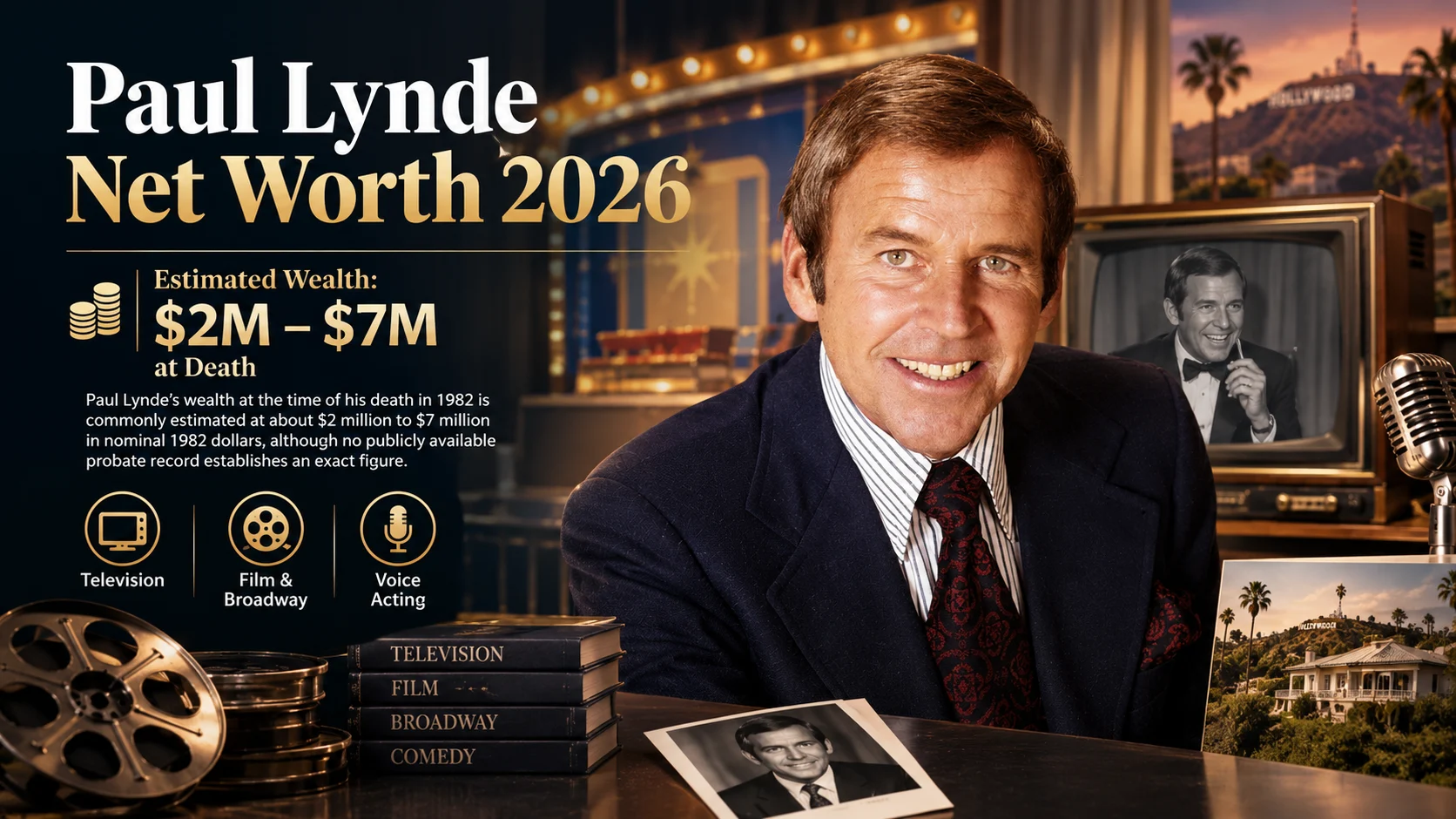
Quick answer: Paul Lynde’s wealth at the time of his death in 1982 is commonly estimated at about $2 million to $7 million in nominal 1982 dollars, although no publicly available probate record establishes an exact figure; the upper-end $7 million estimate is frequently cited by celebrity-finance sources and reflects his long television, film, Broadway and comedy career.
Paul Lynde’s net worth at the time of his death in 1982 is commonly estimated at $2 million to $7 million in 1982 dollars, although no publicly verified probate record establishes his exact wealth. Best remembered for his sharp wit, distinctive voice, and memorable television performances, Lynde built a successful entertainment career spanning sitcoms, game shows, Broadway, film, and comedy. His work on Bewitched, his appearances on Hollywood Squares, and his Broadway success helped establish his reputation as one of television’s most recognizable comic personalities.
While some celebrity-finance sources cite an estimated $7 million fortune, that figure should not be treated as a confirmed estate valuation. This article examines Paul Lynde’s net worth, career earnings, major sources of income, and financial legacy, distinguishing reported estimates from publicly documented facts.
Disclaimer: Net worth figures are estimates based on publicly available data and may vary.
Bio Data Table
| Category | Paul Lynde |
| Full Name | Paul Edward Lynde |
| Date of Birth | June 13, 1926 |
| Age as of 2026 | Would have been 100 |
| Place of Birth | Mount Vernon, Ohio, United States |
| Nationality | American |
| Height | Approximately 5 ft 11½ in, according to IMDb |
| Weight | Not publicly verified |
| Health Conditions | Not publicly verified as a comprehensive medical history; biographical sources report alcohol-related problems, while his death was attributed to a heart attack |
| Religion | Not publicly verified |
| Education | Northwestern University; studied drama |
| Profession / Industry | Actor, comedian, voice artist, television personality |
| Zodiac Sign | Gemini |
| Marriage / Relationship Status | No wife or children were identified in contemporary probate reporting; other relationship details are not reliably documented |
| Children | No children identified in contemporary probate reporting |
| Estimated Net Worth | Commonly cited estimates range from about $2 million to $7 million at death |
| Social Media Accounts | None; Lynde died decades before modern social-media platforms |
| Still Alive | No. Died January 10, 1982 |
| Famous For | Hollywood Squares, Bewitched, Bye Bye Birdie |
Biographical sources consistently identify Lynde as an American actor and comedian born in Mount Vernon, Ohio, who studied drama at Northwestern University before moving to New York and pursuing entertainment professionally.
Who Is Paul Lynde? Background & Early Life
Paul Edward Lynde was born on June 13, 1926, in Mount Vernon, Ohio. He developed an interest in performance early and eventually studied drama at Northwestern University, where he was part of a generation of students who would go on to work in American entertainment. He graduated in 1948 and subsequently moved to New York City.
His first years in New York were not an immediate route to television wealth. Lynde worked on establishing himself as a comedian and performer, eventually gaining attention through nightclub comedy and stage work.
His major Broadway breakthrough came with New Faces of 1952. The production gave Lynde a national theatrical profile and helped establish the distinctive comic persona that later became central to his television career.
Lynde later appeared in the Broadway production of Bye Bye Birdie, playing Harry MacAfee. He reprised the role in the 1963 film adaptation. His stage work therefore became an important bridge between his early comedy career and his expanding television and film opportunities.
During the 1960s, Lynde became a familiar television face. He appeared on numerous sitcoms and variety programs and developed a recognizable performance style built around his voice, timing, facial expressions and sharply delivered one-liners.
The career turning point was Hollywood Squares.
Lynde made his debut on the show in 1966 and eventually became its famous center-square personality. IMDb records more than 1,000 episodes for his participation, while historical accounts commonly cite approximately 1,083 appearances.
That long-running television exposure helped transform Lynde from a successful character actor into a nationally recognizable comedy personality.
Paul Lynde Net Worth 2026: Estimate
The most important qualification in researching Paul Lynde net worth is that there is no publicly verified financial statement establishing a precise personal net worth at his death.
One widely cited celebrity-finance source currently lists Lynde’s net worth at $7 million at the time of his death. However, the same site’s broader celebrity listing has historically presented a lower inflation-adjusted interpretation, illustrating how easily different presentations of historical celebrity wealth can become confusing.
Other websites have published estimates around $5 million or lower, but these figures generally do not provide a primary financial record establishing the amount. Because the available evidence is incomplete, a responsible article should not present $7 million as a confirmed probate valuation.
A reasonable editorial framing is therefore:
Estimated historical net worth at death: approximately 2million–7 million in 1982 dollars, with $7 million being the most frequently cited upper-end estimate.
The range is deliberately cautious because contemporary reporting about Lynde’s estate confirms that he left assets to family members but did not disclose the total dollar value.
UPI reported shortly after his death that Lynde’s will placed the bulk of his estate into trusts benefiting his sisters, Grace Rice and Helen Lynde. The report identified executors and individual bequests but did not state the overall estate value.
That distinction matters.
Career Earnings Were Not the Same as Net Worth
Lynde’s career generated income through acting, television appearances, Broadway, comedy and voice work. But those earnings cannot simply be added together and called net worth.
A person’s net worth is broadly the value of assets minus liabilities.
For Lynde, the calculation would potentially have involved:
- Television compensation
- Film and stage income
- Comedy and appearance fees
- Voice-acting income
- Residual or contractual income where applicable
- Real estate
- Personal property
- Investments
- Taxes
- Living expenses
- Management and professional fees
- Any debts or liabilities
The public record does not provide enough information to calculate each category accurately.
That is why the commonly repeated $7 million figure should be treated as an estimate, not an audited balance sheet.
Net Worth Growth Timeline
Before Fame
Lynde’s early financial years were primarily about establishing himself as a performer.
After graduating from Northwestern University in 1948, he moved to New York and worked toward a career in comedy and theater. His early nightclub and Broadway work provided professional momentum but does not appear to have generated the type of wealth associated with his later television career.
At this stage, income was largely performance-based and career development was more important than asset accumulation.
Breakthrough Phase
The New Faces of 1952 Broadway appearance represented an important professional breakthrough.
His subsequent work in theater, television and film diversified his income opportunities. His role in Bye Bye Birdie was particularly important because the Broadway production became a successful cultural property and Lynde also appeared in the film adaptation.
His television appearances throughout the 1960s further expanded his visibility.
The biggest financial development, however, was his association with Hollywood Squares.
Peak / Recent Years
Lynde’s Hollywood Squares years represented the most sustained period of mainstream television exposure in his career.
He became synonymous with the show’s center square, giving him recurring visibility across a large number of episodes. IMDb’s current listing credits him with more than 1,000 episodes of the daytime series.
He also appeared in television specials, variety programming, films and animated productions.
By the late 1970s and early 1980s, however, his career was changing. He continued working, but his output and television opportunities were not identical to the peak years.
Lynde died in Beverly Hills on January 10, 1982, at age 55.
Main Sources of Income
Television Income
Television was likely the central financial engine of Lynde’s later career.
His long association with Hollywood Squares gave him an unusually consistent television platform. Unlike an actor whose income depends entirely on individual films, a recurring television personality could benefit from repeated appearances and sustained national exposure.
Lynde also appeared on numerous sitcoms, variety programs and television specials.
His television work included Bewitched, where he became known for playing Uncle Arthur, as well as appearances on many other programs.
Exact contract amounts for most of these appearances are not publicly verified.
Film and Stage Earnings
Broadway was an important part of Lynde’s career foundation.
His appearance in New Faces of 1952 helped launch his professional profile, while Bye Bye Birdie gave him another major stage and film opportunity.
His filmography also included comedy productions such as The Glass Bottom Boat, Send Me No Flowers and other projects during the 1960s and 1970s.
These projects contributed to his career earnings, although public records do not provide a comprehensive total.
Comedy and Personal Appearances
Lynde’s background as a stand-up comedian remained important even after television made him famous.
His comedic identity helped make him attractive to variety shows, guest appearances and specials.
This was an important element of his business model: his personality itself was the product.
Voice Acting
Lynde also worked as a voice performer.
His distinctive voice became especially recognizable in animation, including the role of Templeton in Charlotte’s Web and other animated projects.
Voice work provided another entertainment revenue stream while reinforcing the value of his recognizable vocal identity.
Real Estate
There is documented evidence that Lynde owned a Hollywood-area property.
A 2002 San Francisco Chronicle/SFGATE report stated that a 1920s Italian-style villa long owned by Lynde sold for close to its $1.3 million asking price. The property had also previously been associated with actor Errol Flynn.
Importantly, the 2002 sale price cannot simply be added to Lynde’s 1982 net worth. The property was sold approximately two decades after his death, and its later market value reflects decades of real-estate appreciation.
Business Strategy Behind the Wealth
Lynde’s wealth-building strategy was fundamentally different from that of a modern influencer or entrepreneur.
He did not build a technology company or consumer brand. Instead, he built personal brand equity through entertainment.
His financial leverage came from several reinforcing factors.
Recognizable Personal Brand
Lynde had a highly distinctive voice, comic delivery and stage presence.
That made him easy for audiences to recognize and gave television producers a reason to bring him back.
Cross-Medium Career
He did not rely on one medium.
His career included:
- Broadway
- Film
- Sitcoms
- Game shows
- Variety television
- Comedy
- Voice acting
That diversification reduced dependence on any single entertainment format.
Television Visibility
Hollywood Squares gave Lynde repeated national exposure.
The program was particularly valuable because his personality was integrated into the format rather than appearing as a one-time guest. UCLA’s Film & Television Archive describes Lynde as an iconic presence in the center of the show’s famous nine-celebrity format.
Longevity
Lynde worked professionally for roughly three decades.
Long careers can create wealth even when individual project salaries are not publicly documented because repeated professional opportunities compound over time.
Awards & Achievements and Financial Impact
Lynde’s most important achievement was arguably his ability to turn a supporting-comedy persona into a nationally recognizable television identity.
His professional accomplishments included:
- Broadway appearance in New Faces of 1952
- Broadway and film roles in Bye Bye Birdie
- Recurring role as Uncle Arthur on Bewitched
- Long-running association with Hollywood Squares
- Multiple television specials
- Animated voice work
- Recognition by the American Guild of Variety Artists
In 1976, Lynde received an Entertainer of the Year award from the American Guild of Variety Artists after being voted funniest man of the year, according to historical accounts.
Awards do not automatically increase net worth, but recognition can strengthen an entertainer’s bargaining position, booking opportunities and long-term brand value.
Assets & Lifestyle
Real Estate
One of the better-documented assets associated with Lynde was his Hollywood villa.
The property was reportedly once owned by Errol Flynn and was remodeled for Lynde. It remained associated with him for many years before being sold in 2002 for close to $1.3 million.
That later sale provides evidence of property ownership but should not be treated as proof of what the property was worth when Lynde died.
Cars & Luxury
Specific vehicles owned by Lynde are not publicly verified through sufficiently reliable sources.
Claims about particular luxury cars should therefore not be included in a factual net-worth calculation without documentary evidence.
Personal Property
Contemporary UPI reporting provides unusually useful evidence here.
The report on Lynde’s will said that his art collection, furniture and dog went to his sister Helen, while clothing, personal effects and jewelry went to Ralph Rice, the husband of his sister Grace.
The existence of these bequests demonstrates that his estate included valuable personal property, although no comprehensive valuation was reported.
Net Worth Comparison With Peers / Industry
Comparing Paul Lynde with modern entertainers requires considerable caution.
A television personality working in the 1960s and 1970s operated under a completely different economic system from a modern actor or comedian.
There was no streaming economy comparable to today’s market, no social-media sponsorship industry and no YouTube advertising ecosystem.
Lynde’s financial profile is more appropriately compared with other established television comedians and character actors of his generation.
Even then, peer net-worth figures are often estimates rather than documented financial statements.
The useful comparison is therefore not simply the size of the number. It is the career structure:
| Financial factor | Paul Lynde’s career |
| Primary platform | Network television |
| Major recurring property | Hollywood Squares |
| Stage income | Broadway |
| Film income | Feature films |
| Additional entertainment | Variety shows and specials |
| Voice work | Animation |
| Asset diversification | Documented real-estate ownership |
| Estate structure | Trusts and family bequests reported in 1982 |
| Exact net worth | Not publicly verified |
Controversies, Challenges & Financial Risks
Lynde’s career was not without challenges.
Biographical accounts report serious problems involving alcohol and public incidents during parts of his later career. Biography.com notes that his drinking problems affected his professional and personal life.
From a financial perspective, issues affecting an entertainer’s ability to work can have consequences beyond immediate income.
Potential effects include:
- Reduced bookings
- Lost television opportunities
- Higher personal expenses
- Professional management costs
- Damage to negotiating leverage
- Reduced ability to maintain a consistent workload
However, it would be inappropriate to assign a specific dollar amount to these effects without financial records.
There is also the broader risk inherent in entertainment careers: income can fluctuate substantially depending on demand, television contracts and public visibility.
Philanthropy & Social Impact
Publicly verified philanthropy information is limited.
The strongest publicly documented information concerning Lynde’s posthumous financial arrangements concerns his estate planning rather than charitable giving.
His 1965 will, reported by UPI after his death, directed the bulk of his estate into trusts benefiting his sisters.
Lynde’s broader cultural impact is better documented.
His comic style, voice and television persona have remained recognizable decades after his death. His work on Hollywood Squares in particular became part of American television history.
How Paul Lynde Made Money Outside His Core Profession
Because Lynde was an entertainer rather than an entrepreneur, it is important not to manufacture modern-style income categories around him.
His additional revenue opportunities primarily came from adjacent entertainment activities:
- Television specials
- Guest appearances
- Variety programming
- Voice acting
- Film roles
- Stage performances
- Personal appearances
- Real-estate ownership
There is insufficient reliable evidence to assign percentages to these sources.
Similarly, claims about major investment portfolios, company ownership or extensive business holdings are not publicly verified.
Paul Lynde’s Estate and Financial Legacy
Because Lynde died in 1982, the appropriate modern financial question is not whether he continues earning a personal salary.
It is what happened to the economic value associated with his work and estate.
UPI’s contemporary report stated that Lynde’s will placed the bulk of his estate into trusts for his sisters, Grace Rice and Helen Lynde. It also documented specific gifts of personal property and a $10,000 conditional bequest to his brother’s adopted son.
The report did not disclose the estate’s total value.
That omission is central to any responsible discussion of Paul Lynde net worth.
Later exploitation of television programs, films, animation and other entertainment properties can potentially generate licensing or residual-related income for rights holders and estates, but the precise amount attributable to Lynde’s estate is not publicly verified.
Therefore, it would be misleading to claim that a specific amount of annual posthumous income is still being generated.
Future Net Worth Projection
Paul Lynde does not have a personal future net-worth trajectory because he died in 1982.
For a 2026 analysis, the relevant concept is legacy or estate value.
The financial value associated with his work can theoretically be affected by:
- Continued television reruns
- Streaming availability
- Film and television licensing
- Animation distribution
- Merchandise
- Biography and documentary interest
- Re-releases of archival material
- Renewed interest in classic television
- Licensing of his name, image or performances where applicable
However, there is not enough publicly verified financial information to calculate a reliable 2026 estate value.
It would also be incorrect to simply inflate the historical $7 million figure and call the result his “2026 net worth.” Inflation-adjustment measures the changing purchasing power of money; it does not reconstruct the actual assets, liabilities, taxes and estate distributions associated with a deceased person’s finances.
Frequently Asked Questions
What was Paul Lynde’s net worth?
Paul Lynde’s net worth at death is commonly estimated at $2 million–$7 million, though the exact figure was never publicly verified.
How did Paul Lynde make his money?
He earned primarily through television, film, Broadway, comedy, variety shows, and voice acting, with Hollywood Squares being especially significant.
Was Paul Lynde wealthy when he died?
Yes. Lynde built a substantial estate and reportedly left much of it in trusts for his sisters.
Did Paul Lynde marry or have children?
No. Lynde had no surviving wife or children when he died; his estate primarily benefited his sisters and relatives.
What was Paul Lynde famous for?
Audiences knew him best for Hollywood Squares, Bewitched, and his role as Harry MacAfee in Bye Bye Birdie.
Did anyone confirm Paul Lynde’s net worth figure?
No. The often-cited $7 million figure is a third-party estimate, not a verified probate valuation.
Conclusion
To understand Paul Lynde’s net worth, consider it a historical wealth figure rather than a current personal-finance figure.
The most frequently cited estimate places Lynde’s wealth at approximately $7 million at the time of his death in 1982, while other published estimates have placed his wealth lower. Because the surviving public record does not provide a complete probate valuation, a cautious editorial range of roughly $2 million to $7 million in 1982 dollars is more defensible than presenting one number as fact.
Lynde built that wealth through a remarkably broad entertainment career spanning Broadway, film, television, comedy, variety programming and voice acting. His long-running Hollywood Squares role was especially important, making him one of the most recognizable television comedians of his generation.
Net worth figures are estimates based on publicly available data and may vary.