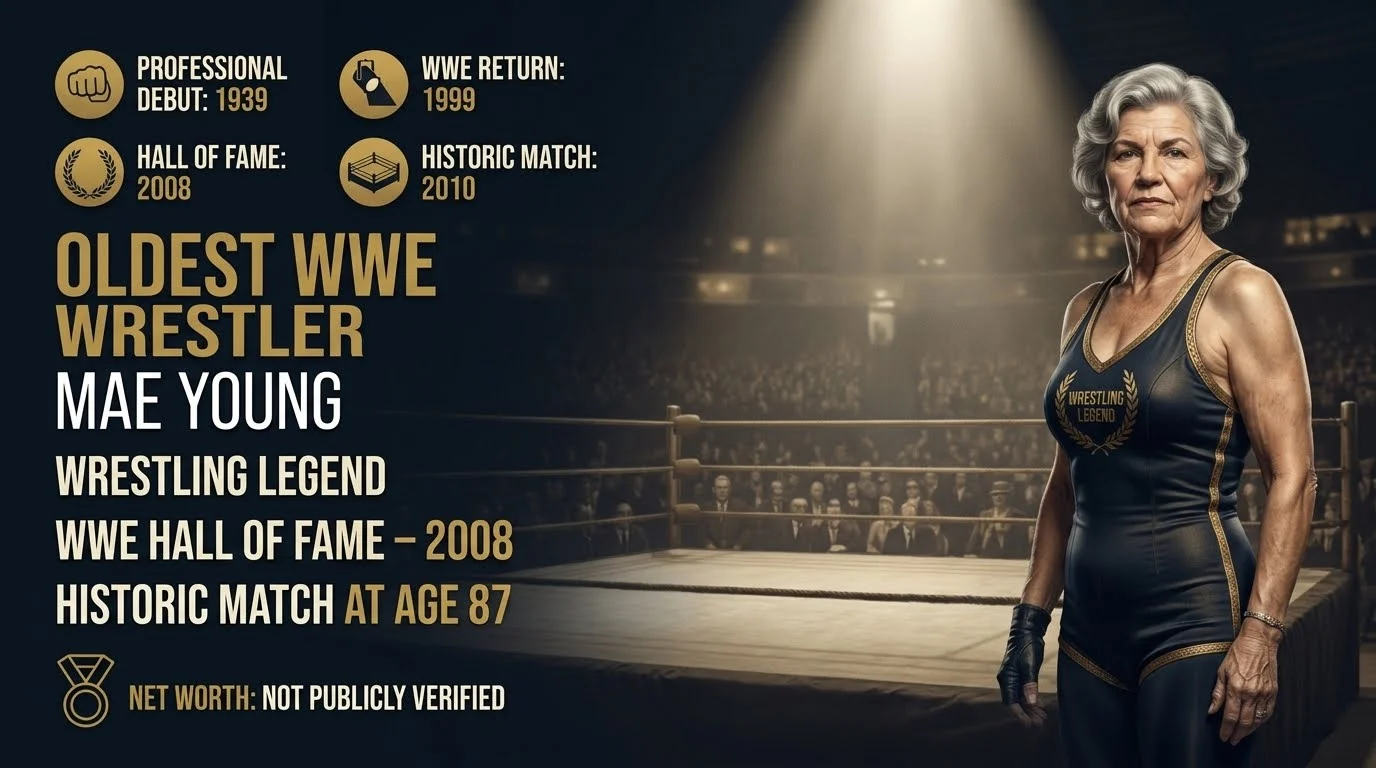
Quick answer: Mae Young is widely recognized as one of the oldest performers to compete in WWE, wrestling a televised match at approximately 87 years old in November 2010; however, her 2026 net worth and estate value are not publicly verified, and no reliable financial records support a precise estimate.
When people search for the oldest WWE wrestler, Mae Young is one of the most important names they encounter. Born on March 12, 1923, she entered professional wrestling in 1939 and continued making memorable appearances long after most performers would have retired. Her November 15, 2010, match against LayCool demonstrated an unusual level of career longevity.
At 87 years and 248 days old, Young participated in a WWE handicap match on the Old School edition of Monday Night Raw. Although the short match involved assistance from other female performers, it remains a remarkable documented example of wrestling longevity. A specialist historical wrestling publication identifies her performance as the oldest verified professional wrestling match by a competitor in its research. This is a historical record claim, not an officially certified WWE leaderboard.
Her financial story, however, requires a different approach. Although her wrestling career spanned several decades, publicly available sources do not establish her lifetime earnings, personal assets, liabilities, or estate value. Assigning her a specific net worth in 2026 would therefore create a misleading impression of financial certainty.
Bio Data Table
The following biography prioritizes WWE’s official historical profile and established newspaper reporting. Information from secondary wrestling databases is identified where appropriate rather than treated as equivalent to official records.
| Biographical field | Verified information |
|---|---|
| Full Name | Johnnie Mae Young |
| Professional Name | Mae Young |
| Date of Birth | March 12, 1923 |
| Age at Death | 90 years, 10 months, approximately |
| Age in 2026 | Would have been 103 years old |
| Place of Birth | Sand Springs, Oklahoma, United States |
| Nationality | American |
| Height | 5 feet 7 inches (170 cm), as reported by WWE |
| Weight | Not publicly verified by a sufficiently authoritative source |
| Health Conditions | A kidney ailment was reported during her final illness; no verified comprehensive medical history |
| Religion | Not publicly verified |
| Education | Attended school in the Sand Springs, Oklahoma, area; highest qualification and graduation status not publicly verified |
| Profession | Professional wrestler and wrestling trainer |
| Industry | Professional wrestling and sports entertainment |
| Zodiac Sign | Pisces |
| Marital Status | Never married, according to her obituary |
| Children | No children, according to her obituary |
| Net Worth | Not publicly verified |
| Social Media | No verified personal social media accounts |
| Date of Death | January 14, 2014 |
| Place of Death | Columbia, South Carolina, United States |
| Still Alive | No |
| Famous For | Women’s wrestling pioneering, nine decade career, WWE appearances, and Hall of Fame recognition |
Who Was Mae Young? Background & Early Life
Who Was Mae Young? Background and Early Life
Mae Young was born Johnnie Mae Young on March 12, 1923, in Sand Springs, Oklahoma. She grew up during the Great Depression in a family environment that WWE’s historical retrospective describes as financially and socially challenging. Her mother raised her and eight siblings, while her father played little role in her upbringing.
Young developed an interest in athletics early in life. She participated in school sports and demonstrated an unusually competitive personality. According to WWE, she was a national champion softball player and an accomplished school athlete. The official WWE biography also describes her involvement in football related activities and her willingness to compete physically with boys.
These experiences helped establish the athletic foundation that later supported her wrestling career.
Her introduction to professional wrestling
Young entered professional wrestling in 1939, when she was approximately 15 years old.
WWE’s historical account describes how she encountered Mildred Burke, one of the most prominent women’s wrestling champions of that era, at the Tulsa Coliseum. Young reportedly challenged Burke, but promoter Billy Wolfe did not immediately arrange a match between the established champion and the inexperienced teenager. Instead, another wrestler, Gladys Gillem, faced her. Young impressed the wrestling group and subsequently became involved in the professional circuit.
She began traveling across the United States, competing in different cities and developing a reputation as an aggressive performer.
Her early career was not built around the modern WWE system of television contracts, global merchandise distribution, and standardized corporate entertainment agreements. Instead, the business operated through promoters, regional territories, live events, and touring arrangements.
The influence of Mildred Burke
Mildred Burke played an important role in Young’s introduction to professional wrestling.
Burke was a major women’s wrestling attraction and helped shape the professional environment in which Young developed. The two also became associated with early international expansion. WWE records their participation in a postwar Japanese wrestling tour in 1954.
Their careers illustrate how women’s professional wrestling developed through individual performers who worked across territories and international markets.
Training The Fabulous Moolah
Young also contributed to wrestling through training and mentorship.
One of her most recognizable professional relationships was with Lillian Ellison, later known as The Fabulous Moolah.Young and Mildred Burke helped train Ellison, who eventually became a major figure in women’s wrestling.This relationship is important because Young’s influence extended beyond her own performances. She helped pass wrestling experience to another generation of competitors.
Her contribution to women’s wrestling therefore included both in ring work and the development of future talent.
Returning to WWE in 1999
After decades in professional wrestling, Young returned to WWE programming in 1999 alongside The Fabulous Moolah.
This return introduced her to an audience that was considerably younger than the generation that had watched her earlier career. Rather than trying to recreate her original wrestling persona, Young embraced the entertainment style of WWE’s Attitude Era. Her appearances involved comedy, unconventional storylines, physical stunts, and interactions with younger performers.
The return significantly increased her visibility and helped establish her as a recognizable historical figure within WWE.
Oldest WWE Wrestler | Mae Young’s Record in 2026
The strongest documented example associated with the oldest WWE wrestler search is Mae Young’s November 15, 2010, match against LayCool.
However, it is important to distinguish three different historical questions:
- Who was the oldest person to compete in a documented professional wrestling match?
- Who was the oldest woman to compete in a professional wrestling match?
- Who was the oldest wrestler to compete in a WWE match?
These are related but not identical records.
Mae Young’s historic 2010 match
On November 15, 2010, WWE presented its Old School edition of Monday Night Raw.
Young appeared alongside the Bella Twins and became involved in a confrontation with LayCool, the pairing of Layla and Michelle McCool. The confrontation led to a no disqualification, two on one handicap match.
The match was brief and involved assistance from other female WWE performers. Young ultimately covered Layla for the winning pinfall. Using her documented birth date of March 12, 1923, Young was 87 years and 248 days old.
The event is particularly notable because she was not simply making a backstage appearance. She participated in a formally presented wrestling match.
Was Mae Young officially recognized as WWE’s oldest wrestler?
There is an important qualification.
WWE officially recognizes Young’s career across nine different decades, but its published biography does not establish a comprehensive, formally certified oldest wrestler leaderboard.Professional wrestling historians have identified her 2010 performance as an extraordinary age record.
Therefore, the most defensible wording is:
Mae Young is one of the oldest documented performers to compete in WWE, and her match at 87 years and 248 days is widely cited as a historic professional wrestling longevity record.
This wording avoids turning a specialist historical record into an unsupported official WWE certification.
Mae Young Net Worth 2026 | What Can Actually Be Established?
Mae Young’s net worth is an area where financial reporting requires particular caution.
Several websites publish estimated fortunes for famous wrestlers, but a published figure does not automatically establish that the person owned assets of that value.
In Young’s case, reliable public sources document her career, achievements, and historical importance. They do not establish a complete financial balance sheet.
Financial verification summary
Not publicly verified
No defensible numerical personal net worth or estate valuation
| Financial category | Evidence |
|---|---|
| Lifetime wrestling earnings | Not publicly verified |
| WWE contract payments | Not publicly verified |
| Match compensation | Not publicly verified |
| Training income | Not publicly verified |
| Television appearance fees | Not publicly verified |
| Real estate ownership | Not publicly verified |
| Investment portfolio | Not publicly verified |
| Estate valuation | Not publicly verified |
Why a net worth estimate is difficult
Young’s professional career began in a period when wrestling operated very differently from modern sports entertainment.
Regional promoters organized matches, controlled bookings, and negotiated arrangements with performers. Her career included different wrestling markets, decades of changing business practices, and later WWE television appearances.
Without financial records, it is impossible to determine:
- How much money she earned during each period.
- What percentage of event revenue she received.
- How much she paid in taxes and professional expenses.
- Whether she accumulated substantial investment assets.
- What properties or other assets she personally owned.
- Whether she had outstanding liabilities.
- What assets remained in her estate after her death.
These are essential considerations when calculating net worth.
Career earnings versus personal net worth
These terms should not be treated as interchangeable.
| Financial term | Meaning |
|---|---|
| Gross earnings | Total income received before deductions |
| Career earnings | Combined professional income over a working lifetime |
| Salary | Regular contractual compensation |
| Appearance fees | Payments for individual events or media engagements |
| Business revenue | Total business income before operating expenses |
| Personal assets | Property, cash, investments, and other owned valuables |
| Net worth | Total assets minus total liabilities |
| Estate value | Assets and liabilities considered under applicable estate arrangements after death |
For example, a wrestler might receive payments from hundreds of matches over a long career but retain only a portion after taxes, living costs, travel, management arrangements, and other expenses.
Likewise, a long professional career does not automatically indicate a large estate.
Editorial conclusion: No reliable evidence supports assigning Mae Young a specific net worth range in 2026.
Net Worth and Career Timeline
Although her financial figures are unavailable, her professional milestones provide a useful framework for understanding the development of her earning opportunities.
Before fame | 1923–1939
Young spent her early years in Sand Springs, Oklahoma.
Her interest in sports and competitive activities provided the foundation for her entry into professional wrestling. Before becoming a recognized performer, she had no publicly documented major business ownership, entertainment company, or investment portfolio. Her financial position during childhood is not publicly established.
Income classification: No verified professional earnings before her wrestling debut.
Early wrestling career: 1939–1940s
Young began competing professionally as a teenager.
She traveled with wrestling groups and participated in matches against established female performers. Her primary professional opportunities came from wrestling bookings and live events. The industry depended on regional promoters, attendance, and touring schedules. Her individual payments and total income remain unknown.
Income classification: Event based professional income.
Established career | 1950s–1980s
Young continued working in professional wrestling and became involved in training.
Her international work, including the 1954 Japanese tour, demonstrated her participation in the development of women’s wrestling beyond the United States. Training and professional mentoring also became part of her industry contribution. However, no verified financial records establish the income she earned from international events or coaching.
Income classification: Wrestling bookings and possible training related income.
WWE recognition | 1999–2008
Young’s return to WWE introduced her to a larger television audience.
Her appearances during the Attitude Era helped transform her from a historical wrestling performer into a recognizable sports entertainment personality. Her WWE Hall of Fame induction in 2008 further strengthened her historical reputation.
These achievements could have improved her professional opportunities, but individual compensation remains undisclosed.
Income classification: Television appearances and possible event compensation.
Final documented wrestling match | 2010
Young’s match against LayCool became an important milestone in professional wrestling history.
Her age at the time attracted attention from fans, wrestling journalists, and historians. The appearance reinforced her position as a performer whose career had extended across generations.
Income classification: WWE appearance and match related compensation, not publicly verified.
Death and historical legacy | 2014–2026
Young died on January 14, 2014, at age 90.
Her financial story consequently shifted from personal income to the question of estate ownership and historical legacy. WWE continues to preserve her career through its historical profile and video material.
However, continued archival exposure does not establish that her estate receives royalties or licensing payments.
Main Sources of Income
Young’s professional activities identify several possible income categories, although not all have verified payment records.
1. Professional wrestling
Wrestling was Young’s central occupation.
Her career included regional competitions, international performances, and later appearances within WWE. During the early decades, professional wrestling was largely driven by live events and promoter controlled booking arrangements. Performers depended on their ability to attract audiences and secure bookings.
Young’s decades long career demonstrates considerable professional experience, but the total financial value of that work remains unknown.
2. WWE appearances
Her return in 1999 created a new period of professional visibility.
She appeared in WWE programming, including Raw and SmackDown, and participated in special storylines. Her recognizable personality made her a memorable part of WWE’s entertainment programming.
However, WWE has not publicly disclosed her individual contract terms or appearance fees.
3. Wrestling training
Young’s contribution to wrestling included training and mentoring.
Her relationship with The Fabulous Moolah is a particularly important example. Training can generate income through instruction, coaching, and wrestling school arrangements.
However, no reliable records establish the amount Young personally received for training.
4. Documentary and television work
Young appeared in the 2004 documentary Lipstick & Dynamite, which examined the lives and experiences of pioneering women in professional wrestling.
She also appeared on Late Night with Conan O’Brien in 2005. These appearances expanded her public profile outside wrestling audiences.
Nevertheless, individual appearance fees and documentary compensation are not publicly verified.
5. Merchandise and licensing
Young’s historical importance makes her relevant to wrestling memorabilia and archival content.
Her name, photographs, and career footage remain part of professional wrestling history. However, there is no reliable public disclosure establishing her estate’s licensing arrangements, merchandise royalties, or intellectual property revenue.
It would be misleading to describe these as confirmed sources of estate income.
Business Strategy Behind Mae Young’s Long Career
Young was primarily a professional performer, not a publicly documented entrepreneur.
Nevertheless, several career decisions helped preserve her relevance.
Developing a memorable personality
Young embraced the role of a tough wrestling villain, commonly known as a heel.
Her character, mannerisms, and willingness to entertain audiences helped distinguish her from other competitors.
This kind of recognition can improve a wrestler’s booking potential.
Maintaining professional relationships
Her association with Mildred Burke and The Fabulous Moolah connected her to influential figures in women’s wrestling.
These relationships helped maintain her involvement in the industry and contributed to her training work.
Adapting to changing entertainment styles
Her return to WWE in 1999 demonstrated an ability to adapt to a different generation of professional wrestling.
Instead of relying solely on her earlier competitive reputation, she embraced a more entertainment focused role.
This reinvention helped her connect with a new audience.
Preserving long term relevance
Her WWE Hall of Fame induction in 2008 and continued historical recognition reinforced her legacy.
However, professional reputation and commercial brand value are not equivalent to ownership of a business or a measurable personal fortune.
Awards, Achievements and Historical Recognition
Mae Young’s achievements are best evaluated through documented career milestones.
| Achievement | Year | Importance |
|---|---|---|
| Professional wrestling debut | 1939 | Began a career that extended across nine decades |
| International wrestling participation in Japan | 1954 | Helped expand women’s wrestling internationally |
| WWE return | 1999 | Introduced her to a new generation of fans |
| Miss Royal Rumble Bikini Contest | 2000 | Memorable WWE entertainment achievement |
| WWE Hall of Fame induction | 2008 | Formal recognition of her career |
| Historic match against LayCool | 2010 | Competed at approximately 87 years old |
| 90th birthday celebration | 2013 | Celebrated her remarkable longevity |
WWE identifies her Hall of Fame induction, nine decade career, and 2000 Miss Royal Rumble recognition in its official profile.
Financial importance of these achievements
Her achievements could have strengthened her earning opportunities through greater visibility and recognition.
A Hall of Fame induction, for example, can increase a wrestler’s historical importance and provide additional opportunities for interviews, appearances, and documentary participation.
Likewise, a long career may create professional demand even after regular competition ends.
However, no verified evidence establishes the additional income Young received from these achievements.
Assets and Lifestyle
Financial articles frequently associate professional wrestlers with expensive homes, luxury vehicles, and investment portfolios.
Such claims should not be repeated without reliable documentation.
Real estate
The Washington Post obituary reports that Young shared a home in Columbia, South Carolina, with The Fabulous Moolah and another wrestler, Diamond Lil.
However, this does not establish Young’s legal ownership of the property.
No verified public property record or reliable financial disclosure has established her personal real estate portfolio.
Cars and luxury possessions
No sufficiently reliable source establishes a personal collection of luxury vehicles, private aircraft, or other expensive assets belonging to Young.
Her public career centered on professional wrestling rather than luxury branding.
Personal belongings and memorabilia
Historical wrestling costumes, photographs, and signed memorabilia associated with Young may have collector interest.
However, the ownership and value of her personal possessions are not publicly established.
Investments and business assets
There is no reliable public evidence identifying a substantial investment portfolio, independently owned wrestling promotion, or major commercial company belonging to Young.
Asset assessment: Her professional legacy is documented; the value and ownership of her personal assets are not publicly verified.
Net Worth Comparison with Other Wrestling Legends
Comparing Young with other professional wrestlers helps explain the difference between historical importance and financial wealth.
The following comparison focuses on professional contributions rather than unsupported net worth figures.
The Fabulous Moolah
A major women’s wrestling champion, trainer, and longtime associate of Mae Young. Her influence extended across several generations.
Mildred Burke: Founder of the World Women’s Wrestling Association HubPages
Mildred Burke
An influential women’s wrestling champion who helped shape the environment in which Young began her career.
Wendi Richter | WWE
Wendi Richter
An important figure in the expansion of women’s professional wrestling during the 1980s.
Every female champion ever
Trish Stratus
A prominent modern era WWE performer whose career developed in a more commercially established wrestling industry.
Why financial comparisons can be misleading
Young began wrestling in 1939, decades before WWE became a global entertainment company.
Modern performers may benefit from:
- Larger television and streaming distribution.
- More extensive merchandise operations.
- International sponsorship opportunities.
- Better developed contractual arrangements.
- Social media and personal branding.
- More structured entertainment partnerships.
These commercial opportunities were not available in the same form during Young’s early career.
It would therefore be inappropriate to compare her financial position with modern wrestlers using unverified celebrity net worth estimates.
Controversies, Challenges and Financial Risks
Young’s career involved several challenges associated with the historical wrestling industry.
Restrictions on women’s wrestling
Female wrestlers faced significant barriers during the early twentieth century.
Some wrestling markets restricted women’s matches, limiting the opportunities available to performers.
Young entered the business when women had to establish their credibility in an environment dominated by male promoters and competitors.
Promoter controlled business arrangements
The wrestling business of Young’s early career relied heavily on promoters who controlled bookings and event organization.
WWE’s historical retrospective discusses Billy Wolfe’s influence over women’s wrestling and the financial power he exercised within that circuit.
This historical context helps explain why the number of years a wrestler competed cannot be used to calculate lifetime wealth.
It does not, however, establish Young’s individual contractual losses or earnings. WWE
Physical demands of professional wrestling
Professional wrestling involves physical contact, repetitive movement, and injury risks.
Young continued participating in wrestling related entertainment at an advanced age.
Although her longevity is remarkable, no verified financial documentation establishes the total medical or injury related expenses she personally incurred.
Changing industry economics
Professional wrestling changed substantially throughout her career.
Regional promotions gradually gave way to more centralized television and entertainment structures. Performers who began working in the 1930s did not necessarily receive the same commercial benefits as those entering WWE during its later expansion.
Estate and financial uncertainty
Following Young’s death, any remaining assets became a matter of estate administration.
Without publicly established estate accounts, it is impossible to determine the total assets, liabilities, inheritance arrangements, or licensing income associated with her estate. No financial dispute or particular estate valuation should be asserted without supporting documentation.
Philanthropy and Social Impact
Mae Young’s most clearly documented contribution was her influence on women’s professional wrestling.
She competed during a period when women faced significant restrictions and helped demonstrate that female performers could sustain long careers in the industry. Her training work also contributed to the development of younger wrestlers. Her influence is particularly evident through her association with The Fabulous Moolah and her participation in the early expansion of women’s wrestling.
WWE’s continued recognition of her career demonstrates her lasting historical significance.
Publicly verified philanthropy information is limited. There is insufficient reliable information to establish a specific donation total, charitable foundation, or major personal philanthropic program.
Her contribution to wrestling history should be recognized separately from claims about charitable giving.
How Mae Young Made Money Outside Professional Wrestling
Young’s professional activities included several forms of entertainment work beyond traditional wrestling competition.
Documentary appearances
Her participation in Lipstick & Dynamite helped preserve the experiences of early female wrestlers.
The documentary also introduced her story to people who might not have followed wrestling during her active competitive years.
Television appearances
Her 2005 appearance on Late Night with Conan O’Brien demonstrated her ability to entertain audiences outside professional wrestling.
Television appearances can create additional professional income, but her individual compensation has not been disclosed.
Wrestling mentorship
Young’s training and mentoring activities were another contribution to the industry.
Her knowledge and experience had value for aspiring performers, although her coaching arrangements and earnings are not publicly established.
Historical media
Her WWE appearances remain accessible through historical wrestling programming.
This preserves her legacy and maintains her connection to the company’s history.
However, no verified evidence establishes that her estate receives recurring royalties from these materials.
Future Net Worth Projection and Estate Outlook
Because Mae Young died in 2014, it would be incorrect to project future personal earnings for her.
The appropriate financial subject is the potential historical and commercial value of her estate and legacy.
| Factor | Possible long term significance |
|---|---|
| WWE historical archives | Maintains visibility of her career |
| Wrestling documentaries | Creates opportunities for renewed historical interest |
| Memorabilia | Potential collector interest |
| Women’s wrestling history | Preserves her cultural importance |
| Licensing and merchandise | Possible commercial value where rights and agreements permit |
These are potential areas of historical value, not confirmed estate income.
What could influence her legacy value?
The continued growth of women’s professional wrestling may encourage more fans to explore the performers who helped establish the industry.
Young’s career provides an important historical reference point.
Her WWE Hall of Fame recognition and unusual career longevity give her story continuing relevance.
Nevertheless, without verified estate ownership, intellectual property agreements, and financial records, no numerical 2026 estate valuation or future projection is defensible.
Frequently Asked Questions About the Oldest WWE Wrestler
1. Who is the oldest WWE wrestler ever?
Mae Young is one of the oldest documented WWE in ring performers. Her November 15, 2010, match against LayCool took place when she was 87 years and 248 days old.
2. How old was Mae Young in her last WWE match?
Mae Young was 87 years and 248 days old during her November 15, 2010, match against LayCool on Monday Night Raw.
3. What was Mae Young’s net worth in 2026?
Mae Young’s personal net worth and estate value are not publicly verified. No reliable financial disclosure establishes a specific figure.
4. When did Mae Young start wrestling?
Mae Young began her professional wrestling career in 1939, when she was approximately 15 years old, according to WWE’s official biography.
5. When did Mae Young die?
Mae Young died on January 14, 2014, in Columbia, South Carolina, at the age of 90.
6. Was Mae Young inducted into the WWE Hall of Fame?
Yes. Mae Young was inducted into the WWE Hall of Fame in 2008 in recognition of her contribution to professional wrestling.
Conclusion
Mae Young remains one of the most remarkable figures in professional wrestling history. Born on March 12, 1923, she began competing in 1939 and continued making memorable appearances for decades.
Her November 15, 2010, match against LayCool, at 87 years and 248 days old, stands as an extraordinary example of wrestling longevity. Her WWE Hall of Fame induction in 2008 further recognized her contribution to the industry. When examining the oldest WWE wrestler, Young is an essential historical figure because her career connected several generations of professional wrestling.
Her financial history, however, remains less transparent. Although professional wrestling, WWE appearances, training, and media work formed part of her career, reliable information about her lifetime earnings, personal assets, and estate valuation is unavailable. The most responsible conclusion is that Mae Young’s net worth is not publicly verified. Her professional legacy, on the other hand, is well established.