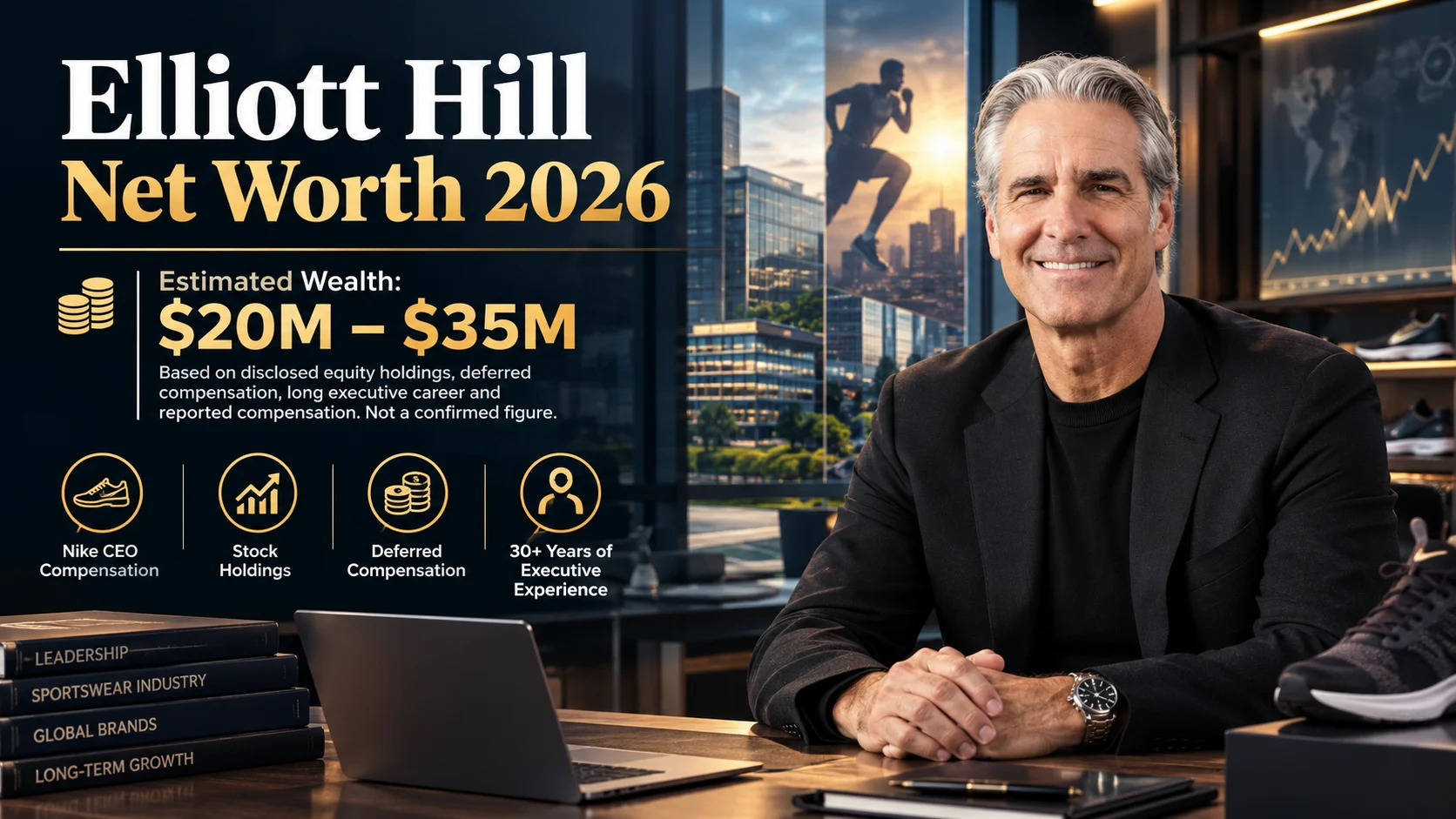
Quick answer: Elliott Hill’s estimated 2026 net worth is approximately 20million–35 million, based on his disclosed Nike equity holdings, deferred compensation, long executive career, and reported compensation; the figure is an informed estimate rather than a publicly confirmed personal balance sheet.
Net worth figures are estimates based on publicly available data and may vary.
Bio Data Table
| Category | Details |
| Full Name | Elliott J. Hill |
| Date of Birth | Not publicly verified |
| Age as of 2026 | 62, according to Nike’s 2026 corporate-governance disclosure |
| Place of Birth | Austin, Texas, United States |
| Nationality | American |
| Height | Not publicly verified |
| Weight | Not publicly verified |
| Health Conditions | Not publicly verified |
| Religion | Not publicly verified |
| Education | B.S. in Kinesiology, Texas Christian University; M.S. in Sports Administration, Ohio University |
| Profession | Business executive / CEO |
| Industry | Sportswear, athletic footwear, consumer brands |
| Zodiac Sign | Not publicly verified |
| Marriage / Relationship Status | Married to Gina Hill |
| Children | Two children, Austin and Peyton |
| Estimated 2026 Net Worth | Approximately 20million–35 million |
| Social Media Accounts | Not publicly verified |
| Still Alive | Yes |
| Famous For | President and CEO of NIKE, Inc. |
Nike’s corporate-governance materials identify Hill as 62 and document his senior positions at Nike. The company also confirms his TCU kinesiology degree and Ohio University master’s degree. TCU and Nike materials identify his wife, Gina, and his two children.
Who Is Elliott Hill? Background & Early Life
Elliott Hill’s career is notable because he did not enter Nike as an established celebrity executive or outside corporate star. He effectively built his career inside the company.
Hill was raised in Austin, Texas, by a single mother who worked as a schoolteacher. In an interview published by Nike, he described growing up in a working-class neighborhood and developing a strong connection to athletics early in life.
He attended Texas Christian University, graduating in 1986 with a degree in kinesiology. TCU has reported that he worked in the university’s athletics department to help pay for his education. He later earned a master’s degree in sports administration from Ohio University.
Before Nike, Hill worked as an assistant athletic trainer with the Dallas Cowboys. His eventual move into Nike began in 1988, initially through an internship and sales-related work.
His progression was unusually broad. Over more than three decades, Hill moved through sales, retail, geographic management and senior leadership positions. Nike’s corporate biography lists roles including vice president/general manager of North America, president of geographies and sales, president of geographies and integrated marketplace, and eventually president of consumer and marketplace.
That progression is important when examining Elliott Hill’s wealth. His fortune did not emerge from one spectacular business sale. Instead, it appears to have developed through decades of executive compensation, stock ownership, long-term incentive awards and deferred compensation.
Elliott Hill Net Worth 2026 Estimate
A reasonable estimate of Elliott Hill’s 2026 net worth is $20 million to $35 million.
The range is deliberately wider than a simple “salary multiplied by years worked” calculation because compensation and wealth are different concepts.
The strongest publicly visible components include:
- Nike stock ownership
- Deferred compensation
- Executive salary and incentives
- Long-term stock and option awards
- Decades of previous Nike compensation
- Potential personal investments and property that are not fully disclosed
Nike’s 2026 proxy statement reports that Hill received $36.34 million in total compensation for fiscal 2026. That figure included a $1.5 million salary, $28.14 million in stock awards, $3.97 million in option awards, $2.22 million in non-equity incentive compensation and approximately $516,000 in other compensation.
However, $36.34 million of compensation does not mean Hill earned $36.34 million in spendable cash.
A large portion consisted of equity awards whose reported value is based on accounting valuations at the time of grant. Some awards vest over multiple years and their eventual economic value can be substantially different from the grant-date accounting value.
That distinction is central to understanding the Elliott Hill net worth estimate.
Publicly Visible Wealth Indicators
An April 2026 SEC filing reported that Hill beneficially owned 265,247.235 shares of Nike Class B common stock following a transaction.
Separately, Nike’s 2026 proxy identifies Hill’s fiscal-2025 deferred-compensation account balance at approximately $9.46 million as of May 31, 2025.
These figures alone demonstrate why a net worth estimate in the tens of millions is more plausible than an estimate based solely on his $1.5 million salary.
At the same time, stock holdings and deferred compensation should not automatically be added together and treated as a complete net worth statement. Taxes, liabilities, other investments, property, family assets and the precise status of restricted or deferred awards all matter.
For that reason, 20million–35 million is best treated as an analytical estimate, not a verified figure.
Net Worth Growth Timeline
Before Fame
Hill’s early financial life is not publicly documented in sufficient detail to calculate his wealth.
His professional foundation was athletics and sports administration rather than finance. He worked in college athletics, pursued graduate education and eventually entered Nike. His early income was therefore much closer to a conventional employee career than the large equity-driven compensation associated with his later executive positions.
Financial character: salary-based and career-building.
Breakthrough Phase
Hill’s major financial breakthrough came from his progression through Nike’s corporate structure.
By 2010, he had become vice president/general manager of North America. He later moved into increasingly senior global roles and became president of geographies and sales and then president of consumer and marketplace.
His 2019 compensation provides a useful historical benchmark. Nike’s SEC-reported compensation data shows Hill received approximately $5.38 million in total compensation in fiscal 2019, including salary, stock awards, incentive compensation and other compensation.
His fiscal 2020 compensation was also substantial, although his retirement timing makes year-to-year comparisons imperfect. Public compensation records show roughly $5.9 million in reported compensation for that year.
Financial character: increasingly equity-based executive compensation.
Peak / Recent Years
Hill retired from Nike in 2020 after more than 30 years with the company.
The retirement did not end his connection with the sportswear business. Nike appointed him president and CEO effective October 14, 2024. His new compensation package included a $1.5 million base salary, a target annual bonus equal to 200% of base salary and a target annual long-term incentive award of $15.5 million.
His actual fiscal-2025 total compensation was $26.02 million, while his fiscal-2026 total compensation rose to $36.34 million.
Financial character: salary plus substantial equity, incentive and long-term compensation.
Main Sources of Income
Core Profession Income
Hill’s primary income source is his career as a senior corporate executive.
As Nike CEO, his contractual base salary is $1.5 million per year.
Salary, however, represents only a fraction of his reported compensation.
For a public-company CEO, compensation commonly includes several layers:
- Base salary
- Annual incentive compensation
- Restricted stock
- Performance stock units
- Stock options
- Deferred compensation
- Retirement-related benefits
- Other executive benefits
Hill’s Nike package reflects this model.
Salary, Incentives and Executive Compensation
Hill’s fiscal-2026 salary was $1.5 million, while his reported total compensation reached $36.34 million. The difference illustrates why searching only for “Elliott Hill salary” can give a misleading picture of his wealth.
His fiscal-2026 package included approximately:
- $1.50 million: salary
- $28.14 million: stock awards
- $3.97 million: option awards
- $2.22 million: non-equity incentive compensation
- $516,000: other compensation
These are reported compensation values rather than a statement that Hill received all of the money as cash.
Nike Stock Ownership
Equity is an important component of Hill’s wealth.
The April 2026 SEC Form 4 showed Hill with 265,247.235 directly owned Nike Class B shares after the reported transaction.
Nike’s stock price fluctuates, so the market value of those shares can change substantially without Hill buying or selling anything.
This creates an important distinction:
Stock value is an asset; stock compensation is not necessarily cash income.
The eventual value of equity awards also depends on vesting, market performance and other conditions.
Deferred Compensation
Another publicly documented component is Hill’s deferred-compensation account.
Nike’s fiscal-2025 proxy reported a balance of approximately $9.46 million as of May 31, 2025.
Deferred compensation can be economically significant because it represents accumulated compensation that has not necessarily been received as ordinary cash income.
It also demonstrates why a simple calculation based on Hill’s annual salary would substantially understate his financial position.
Investments or Ownership Stakes
Nike securities are the most clearly documented investment-related component.
Other personal investments may exist, but a complete public portfolio is not available.
Therefore, claims that Hill owns substantial holdings in unrelated companies, private businesses or large investment portfolios should be treated cautiously unless supported by regulatory filings or reliable documentation.
Publicly verified information is limited.
Business Strategy Behind the Wealth
Hill’s wealth-building strategy is closely connected to a long-term executive career rather than entrepreneurial ownership of a privately founded company.
Three elements stand out.
Long-Term Career Positioning
Hill stayed with Nike for more than three decades before retiring in 2020. His career progressed through multiple functions and geographic markets rather than remaining confined to one specialty. Nike says he held senior leadership positions across Europe and North America.
Consumer and Brand Expertise
Hill’s senior positions placed him close to Nike’s consumer, marketing, retail and geographic operations. Before retirement, he was president of Consumer and Marketplace and had responsibility for commercial and marketing operations for Nike and Jordan Brand.
Equity-Based Executive Compensation
His compensation as CEO demonstrates the importance of ownership-like incentives. His fiscal-2026 compensation contained tens of millions of dollars in stock and option awards.
That structure aligns executive wealth with the company’s stock and long-term performance, although it also introduces market risk.
Awards & Achievements and Financial Impact
Hill’s most significant career achievements are connected to his leadership positions rather than entertainment-style awards.
In 2006, Nike recognized him with a Community Leadership Award. In 2013, the National Football Foundation’s Allstate Sugar Bowl chapter recognized him with a Distinguished American Award.
His professional advancement is arguably more financially relevant than individual awards.
As president of Consumer and Marketplace, he was responsible for major Nike and Jordan Brand commercial operations. Nike has credited him with helping grow the business to more than $39 billion.
Those responsibilities helped establish the executive reputation that ultimately contributed to his selection as CEO in 2024.
Assets & Lifestyle
Real Estate
Hill and his wife have publicly documented connections to Austin, Portland and other locations through their professional and philanthropic activities.
TCU has also reported that the Hills provided a farmhouse in Italy for a residency program for TCU art students.
However, the existence and value of specific personally owned real estate holdings are not sufficiently documented to include a precise property portfolio in his net worth calculation.
Publicly verified property values are limited.
Cars & Luxury
There is no reliable public inventory of Hill’s private automobile collection or luxury purchases.
Given his position as Nike CEO, lifestyle assumptions based solely on corporate status would be inappropriate.
Not publicly verified.
Fashion, Investments & Business Assets
Hill’s professional life is naturally connected to Nike’s sportswear ecosystem, but that does not mean every Nike-related product or property should be treated as a personal asset.
His most clearly documented financial assets are his Nike securities and deferred compensation.
Net Worth Comparison With Peers / Industry
Comparing corporate executives by net worth is difficult because personal wealth information is rarely disclosed in full.
A more reliable comparison is executive compensation.
Hill’s fiscal-2026 total compensation was $36.34 million. His fiscal-2025 total was approximately $26.02 million.
These figures place his compensation in the high-value public-company CEO category, but they should not be interpreted as proof that his personal wealth is equal to one year’s compensation.
Corporate CEOs can have very different financial profiles depending on:
- Years spent at the company
- Stock accumulation
- Previous compensation
- Exercise and sale of options
- Deferred compensation
- Real estate
- Outside investments
- Taxes
- Debt
- Family ownership structures
Hill’s decades-long Nike career makes his wealth profile different from that of a recently appointed CEO with little accumulated equity.
Controversies, Challenges & Financial Risks
Hill’s financial position is closely tied to Nike’s corporate performance.
That creates a significant market-related risk because a substantial portion of executive compensation is connected to equity.
Nike’s 2026 proxy shows that a large part of Hill’s compensation came through stock and option awards.
The value of such awards can rise or fall with Nike’s share price and with the achievement of performance conditions.
Nike has also faced competitive and strategic challenges during Hill’s tenure, including pressure in China, product innovation challenges and changing consumer demand. Recent financial coverage has highlighted those issues.
For Hill personally, the relevant financial risks therefore include:
- Nike stock volatility
- Performance-based compensation
- Long-term equity vesting conditions
- Tax obligations
- Market competition
- Changes in Nike’s operating performance
- Potential changes in executive compensation
- Concentration of wealth in employer-linked equity
These risks are why compensation should never be treated as guaranteed personal wealth.
Philanthropy & Social Impact
Hill has a substantial documented connection to community and educational initiatives.
He serves on the Texas Christian University Board of Trustees, and TCU has reported that he and Gina Hill support students, athletics and academic programs. Their giving has included scholarships, internships and support for university facilities.
Earlier in his career, Hill was also involved with community organizations and youth athletics. Nike has described his involvement with communities in Portland, Bend and Austin.
Before returning to Nike as CEO, he was involved in launching the Travis County Parks Foundation, a nonprofit focused on parks in Austin.
These activities provide evidence of community involvement, although publicly available information does not establish a comprehensive lifetime dollar amount for Hill’s charitable giving.
How Elliott Hill Makes Money Outside His Core Profession
Hill’s wealth is primarily connected to executive compensation rather than a broad celebrity-style portfolio.
The publicly supported secondary components include:
Equity Ownership
His Nike shares represent a substantial publicly observable asset.
Deferred Compensation
His Nike deferred-compensation account had a reported balance of approximately $9.46 million at May 31, 2025.
Board and Community Roles
Hill serves on the TCU Board of Trustees, but there is no reliable public evidence that such service represents a major source of personal income.
Consulting
After retiring from Nike in 2020, Hill kept busy with business consulting and nonprofit work before eventually returning to Nike. Nike’s own profile describes this period.
The size of any consulting income is not publicly verified.
Future Net Worth Projection
Projecting Hill’s future wealth requires separating his income potential from his asset value.
His CEO compensation structure provides significant potential for additional wealth accumulation through salary, annual incentives and equity awards. Nike’s 2024 offer letter established a $1.5 million base salary and a target annual long-term incentive award of $15.5 million for fiscal 2025.
However, future net worth will depend heavily on:
- Nike’s stock performance
- The value and vesting of Hill’s equity awards
- Annual bonus results
- Future compensation decisions
- Taxes
- Personal investment performance
- Property values
- Spending and liabilities
For that reason, it would be inappropriate to assign a precise future dollar figure.
If Hill remains in senior leadership and continues receiving substantial equity compensation, his wealth could reasonably increase over time. Conversely, weaker equity performance could reduce the market value of his holdings even while his salary remains unchanged.
Frequently Asked Questions
What is Elliott Hill’s net worth in 2026?
Elliott Hill’s 2026 net worth is estimated at $20 million–$35 million, based on his Nike compensation, stock ownership and career earnings.
How much does Elliott Hill make as Nike CEO?
Hill earns a $1.5 million base salary. His fiscal-2026 total compensation was approximately $36.34 million.
How much Nike stock does Elliott Hill own?
An April 2026 SEC filing reported that Hill beneficially owned 265,247 Nike Class B shares.
What is Elliott Hill’s main source of wealth?
His wealth primarily comes from his decades-long Nike career, executive compensation, stock awards and deferred compensation.
Is Elliott Hill a billionaire?
No. Publicly available information suggests Hill’s wealth is in the tens of millions, not billions.
Is Elliott Hill’s net worth confirmed?
No. His exact net worth remains private, so the $20 million–$35 million figure is an estimate.
Conclusion
Elliott Hill’s 2026 net worth is estimated at $20 million–$35 million, largely reflecting his decades at Nike, executive compensation, stock holdings and deferred compensation.
Nike reported $36.34 million in fiscal-2026 compensation for Hill, while an SEC filing showed he owned more than 265,000 Nike Class B shares. However, compensation and stock holdings do not equal personal net worth, and his complete assets and liabilities remain undisclosed.
Therefore, his net worth remains an estimate based on publicly available financial information.