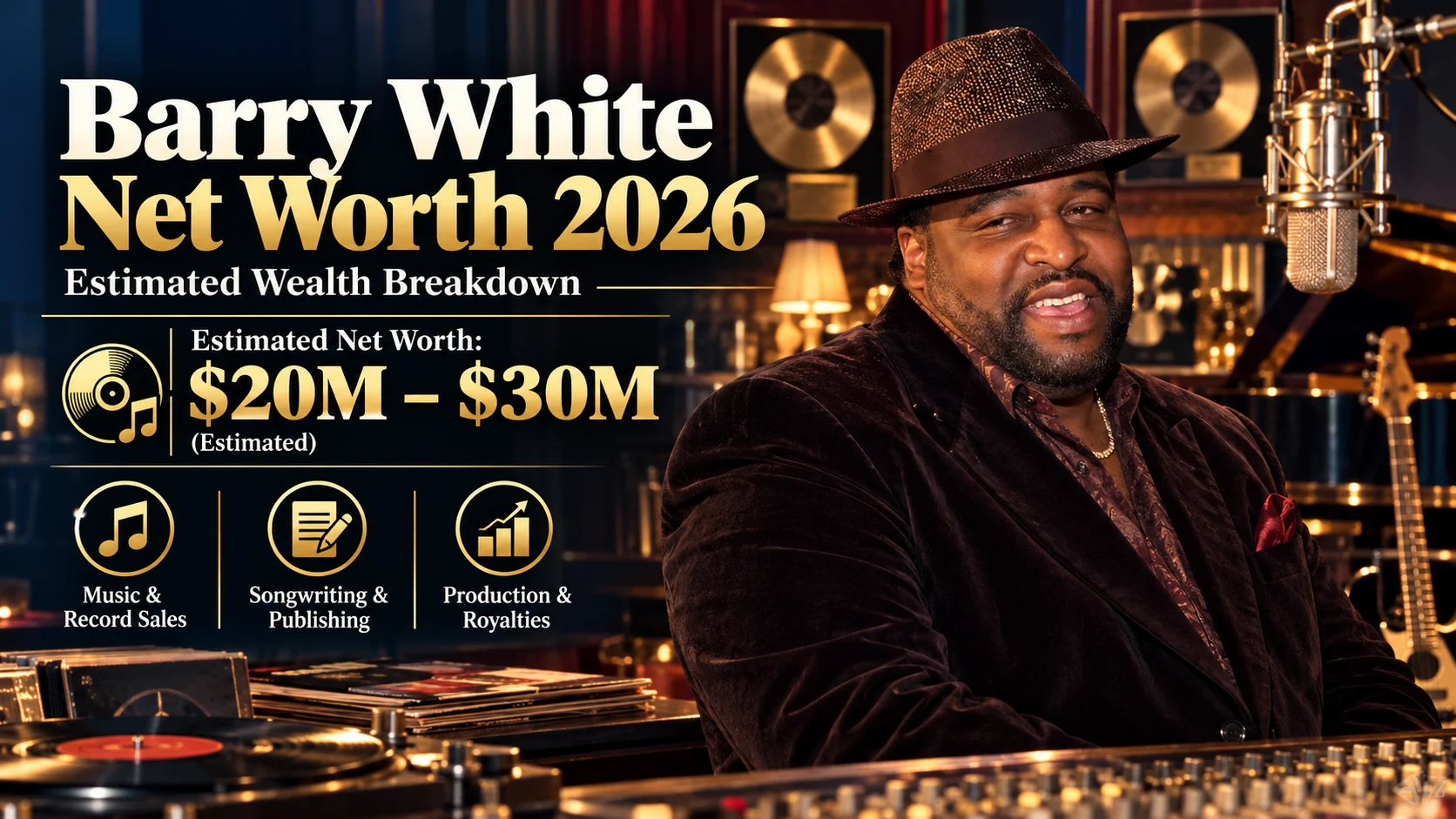
Quick Answer: Barry White’s estimated estate and legacy value in 2026 ranges from $20 million to $30 million, based on figures reported around his 2003 death. However, no authoritative current estate valuation confirms this estimate, including the ongoing value of his music catalog.
Barry White’s net worth in 2026 is often estimated at $20 million to $30 million, based on historical figures associated with the legendary singer’s wealth at death in 2003. But what was Barry White’s net worth at death, and how much could his music royalties and catalog contribute to his lasting financial legacy? Best known for romantic hits such as Can’t Get Enough of Your Love, Babe, White built a fortune through singing, songwriting, record sales, and music royalties.
This article examines Barry White’s fortune, reported estimates of Barry White’s net worth at the time of his death, and what is known about his estate today. It also explores Glodean White’s net worth and related family financial questions, while distinguishing verified facts from speculation. Although searches for Barry White net worth 2025, what is Barry White’s net worth, and Barry White’s net worth remain popular, no authoritative public valuation confirms his estate’s current worth.
Bio Data Table
| Field | Barry White |
| Full Name | Barry Eugene Carter |
| Date of Birth | September 12, 1944 |
| Age as of 2026 | 82 years old if living; died at 58 in 2003 |
| Place of Birth | Galveston, Texas, United States |
| Nationality | American |
| Height | Approximately 6 ft 3½ in / 1.92 m, according to IMDb |
| Weight | Not publicly verified |
| Health Conditions | Hypertension/high blood pressure and kidney failure were publicly reported; he was hospitalized for kidney failure in 2002 |
| Religion | Not publicly verified |
| Education | Attended high school but left school in 1959, according to the Texas State Historical Association |
| Profession / Industry | Singer, songwriter, record producer, composer, arranger; R&B, soul and disco |
| Zodiac Sign | Virgo |
| Marriage / Relationship Status | Married Glodean James in 1974; they were separated but remained legally married until his death |
| Children | Widely reported as nine |
| Net Worth | Estimated estate/legacy value: approximately 20million–30 million; current figure not publicly verified |
| Social Media Accounts | Not publicly verified as personal accounts |
| Still Alive | No — died July 4, 2003 |
| Famous For | His deep bass-baritone voice, romantic R&B recordings, Love Unlimited Orchestra and songs including “Can’t Get Enough of Your Love, Babe” |
Biographical records identify White as Barry Eugene Carter, born in Galveston in 1944. The Texas State Historical Association records his early musical development, professional work and eventual rise as a singer, producer and songwriter. IMDb lists his height at 6 feet 3½ inches.
Who Is Barry White? Background & Early Life
Barry White was born Barry Eugene Carter on September 12, 1944, in Galveston, Texas. He was raised in Los Angeles and was introduced to music early, including classical music and gospel singing. His musical abilities developed well before his eventual breakthrough as a solo recording artist.
His adolescence was difficult. According to the Texas State Historical Association, White left high school in 1959 and was jailed as a teenager after being convicted of stealing tires. During his incarceration, he became particularly influenced by Elvis Presley’s music and subsequently pursued music more seriously.
That early period also illustrates an important point about White’s eventual wealth: his career was broader than simply being a singer.
He worked as a pianist and session musician, performed with vocal groups and later moved into songwriting, arranging and A&R work. His work behind the scenes helped establish the production skills that eventually became central to his career.
In the 1960s, White worked with artists and labels connected to Bob Keane and became involved with the Bobby Fuller Four and other projects. He also arranged Bob & Earl’s “Harlem Shuffle,” demonstrating that his musical value extended beyond his own voice.
His major breakthrough came through production.
White worked extensively with Love Unlimited, a female vocal group that eventually signed with Uni Records. Their 1972 debut album, produced by White, sold more than one million copies. He then developed the Love Unlimited Orchestra, whose instrumental recording “Love’s Theme” became a No. 1 hit.
That combination of performing, songwriting, arranging and production became the foundation of White’s financial model.
Barry White Net Worth 2026 Estimate
The most frequently cited figure for Barry White’s wealth at death is $20 million.
Celebrity Net Worth reports $20 million at the time of his death in 2003. A 2017 estate-planning presentation likewise described White as leaving an approximately $20 million estate. An estate-law discussion published later also cited an estimated estate value of more than $20 million.
Some newer online publications have suggested figures between approximately $20 million and $30 million. Because those higher figures are not accompanied by a publicly available audited estate valuation, they should not be treated as established fact.
Working 2026 estimate
Estimated Barry White estate/legacy financial range: 20million–30 million.
This range is a research estimate, not an official estate statement.
The estimate reflects:
- The frequently reported $20 million estate benchmark
- White’s extensive recording history
- His songwriting and production credits
- The continuing commercial life of his catalog
- Posthumous music sales and licensing potential
- The existence of estate and trust interests
- The absence of a publicly verified current consolidated balance sheet
White’s official site states that his combined worldwide record sales exceeded 100 million. The Hollywood Walk of Fame similarly records worldwide sales above 100 million and emphasizes his extensive gold and platinum success.
But 100 million records sold does not mean $100 million went to White.
Record sales are gross commercial activity. Personal wealth is what remains after contractual splits, production costs, distribution, taxes, management, legal expenses, recording expenses and other obligations.
That distinction is essential to understanding Barry White’s financial history.
Why the 2026 figure is uncertain
White’s estate is not publicly traded and does not publish a current annual financial statement comparable to a public corporation.
Music assets can also be divided among different rights:
- Master recordings
- Songwriting rights
- Publishing interests
- Performance royalties
- Mechanical royalties
- Licensing rights
- Name and likeness interests
- Estate-owned property
- Trust interests
The precise ownership percentages and current valuations of all those assets are not publicly consolidated in one reliable source.
Therefore, the 20million–The 30 million figure should be viewed as an estimated range for the financial footprint of White’s estate and legacy, not a confirmed 2026 balance sheet.
Career Earnings vs. Net Worth
One of the biggest mistakes in celebrity-finance reporting is treating career earnings as equivalent to net worth.
For Barry White, those are very different concepts.
Career earnings represent the money generated during a professional career.
Net worth represents the value of assets and ownership interests minus liabilities.
For a musician, the basic distinction can be expressed as:
Net worth = assets + ownership interests − liabilities
Those assets may include cash, property, investment accounts, publishing rights and other intellectual property.
White had several potential revenue-producing roles simultaneously. He could earn as a vocalist, songwriter, producer, arranger and conductor. That diversified his income opportunities.
However, his gross industry revenue would have been reduced by recording costs, business expenses, management arrangements, taxes and other deductions.
This is why a musician can sell millions of records without necessarily retaining a fortune equivalent to the headline sales figure.
Barry White Net Worth Growth Timeline
Before Fame
White’s earliest professional years were financially modest compared with his later career.
He worked as a musician, pianist, session performer and A&R professional. His early songwriting, arranging and production work provided industry experience rather than the enormous commercial revenues associated with his 1970s breakthrough.
This period was primarily career-building income.
The Texas State Historical Association notes that White’s professional activities expanded during the 1960s, including songwriting, arranging, A&R work and production.
Breakthrough Phase
The 1970s transformed White’s economic position.
His production work with Love Unlimited helped establish him as a major behind-the-scenes creative force. The group’s debut album sold more than one million copies, while the Love Unlimited Orchestra produced the No. 1 instrumental “Love’s Theme.”
White’s own recording career then accelerated.
His 1973 album I’ve Got So Much to Give introduced him as a major solo artist. “I’m Gonna Love You Just a Little More Baby” became a major R&B and pop hit.
The following year brought Can’t Get Enough, which contained two of his signature recordings: “Can’t Get Enough of Your Love, Babe” and “You’re the First, the Last, My Everything.”
The Hollywood Walk of Fame records that “Can’t Get Enough of Your Love, Babe” reached No. 1 on the Billboard Pop chart while “You’re the First, the Last, My Everything” reached No. 2.
This was the phase in which White’s income shifted from relatively diversified professional work toward high-volume recording, performance and intellectual-property income.
Peak / Recent Years
White’s commercial momentum declined during part of the 1980s as musical tastes changed and the disco era ended.
But his career was not permanently damaged.
He returned to chart prominence during the 1990s. Put Me in Your Mix reached No. 8 on the R&B Albums chart, while The Icon Is Love reached No. 1 on the R&B album chart.
His 1999 album Staying Power generated his final major hit and ultimately earned White two Grammy Awards in 2000.
The financial significance of this late-career comeback was important because it demonstrated that White’s catalog and brand remained commercially relevant beyond his original 1970s peak.
Main Sources of Income
Core Profession Income
White’s primary financial engine was music.
He generated income through several interconnected activities:
- Recording
- Live performances
- Songwriting
- Music production
- Arranging
- Conducting
- Album sales
- Singles
- Publishing and royalty participation
This was a more diversified model than that of an artist who only performs songs written by others.
Record Sales and Career Earnings
White’s commercial record sales were substantial.
His official website says combined worldwide record sales exceeded 100 million, while the Hollywood Walk of Fame cites more than 100 million worldwide sales and numerous gold and platinum releases.
The commercial scale of those sales helps explain why a multimillion-dollar estate is plausible.
But sales figures measure market activity rather than White’s personal take-home income.
Songwriting and Publishing
Songwriting represented another important component of White’s financial legacy.
He wrote, arranged and produced much of his own material and contributed to music created through Love Unlimited and the Love Unlimited Orchestra.
That matters because songwriting and publishing rights can continue producing income long after an artist stops performing.
The U.S. Copyright Office has referenced Barry White among the songwriters represented in major music-publishing catalogs, confirming the continuing relevance of his compositions to the publishing ecosystem.
Production and Arrangement
White’s financial value also came from his role as a producer and arranger.
His work with Love Unlimited, the Love Unlimited Orchestra and other performers demonstrated that he could monetize his musical expertise without appearing as the primary vocalist on every project.
That expanded the number of revenue-producing activities connected to his career.
Posthumous Royalties and Licensing
After White’s death, his music did not disappear from the commercial marketplace.
Recordings can continue to generate revenue through:
- Streaming
- Digital downloads
- Physical releases
- Radio performance
- Film and television licensing
- Advertising
- Compilation albums
- Reissues
- Cover versions
- Publishing royalties
A particularly useful illustration of the economics of White’s songwriting catalog comes from royalty-market records: an asset representing 25% of a songwriter’s share of public-performance royalties for “You’re the First, the Last, My Everything” was sold for $73,000 in a Royalty Exchange transaction. That transaction involved a songwriter’s royalty share, not necessarily White’s estate, so it should not be interpreted as a valuation of White’s entire catalog.
Business Strategy Behind the Wealth
Barry White’s financial success was built less on a conventional corporate empire and more on creative ownership and multiple positions within the music business.
Reputation
White developed an instantly recognizable artistic identity.
His voice, production style and romantic persona became closely associated with his name. That helped differentiate him in a crowded recording industry.
Ownership and Creative Control
White did more than perform.
He wrote, arranged and produced music, and created the Love Unlimited Orchestra. His involvement across multiple parts of the production process potentially created more opportunities to participate in music revenue than a performer-only model.
Brand Leverage
His voice became an identifiable commercial asset.
The official Barry White site describes him as a singer-songwriter, arranger, producer and multi-instrumentalist while emphasizing his extensive gold and platinum catalog.
Long-Term Catalog Value
Perhaps the most important financial lesson from White’s career is that music can remain economically useful long after its initial release.
A successful song can continue producing revenue through different forms of consumption and licensing decades after release.
That makes intellectual property different from ordinary earned income.
Awards & Achievements and Financial Impact
Barry White’s achievements provide useful context for his earning power.
More Than 100 Million Worldwide Record Sales
White’s official website reports combined worldwide record sales exceeding 100 million.
Commercial volume at that scale indicates substantial historical demand for his music.
Two Grammy Awards
White received two Grammy Awards for “Staying Power” at the 42nd Grammy Awards in 2000: Best Male R&B Vocal Performance and Best Traditional R&B Vocal Performance. The Recording Academy lists 11 Grammy nominations overall.
Awards do not directly translate into a fixed dollar amount, but major industry recognition can increase an artist’s prestige, booking value, media visibility and catalog relevance.
Hollywood Walk of Fame
White received a star on the Hollywood Walk of Fame. The Walk of Fame’s official biography highlights his commercial success, his No. 1 recordings and his more than 100 million worldwide record sales.
His achievements therefore contributed to the long-term cultural value surrounding his name and music.
Assets & Lifestyle
Real Estate
Public sources have discussed property as part of White’s estate, but a complete, current inventory of his real-estate holdings and their present values is not publicly verified.
Accordingly, it would be misleading to assign a specific value to a Barry White property portfolio without verified property records and ownership documentation.
Cars & Luxury
White was known for his distinctive public image, but a comprehensive, independently verified list of vehicles and luxury possessions is not publicly established.
Specific car values should therefore be treated cautiously.
Fashion and Personal Brand
White’s distinctive appearance, deep voice and romantic musical persona became important elements of his cultural identity.
However, there is insufficient reliable public evidence to assign a separate financial valuation to his personal-brand assets.
Music and Intellectual Property
For a musician such as White, the most economically important assets may not have been physical luxury goods.
The more significant long-term assets can be intellectual property:
- Recordings
- Compositions
- Publishing interests
- Royalty streams
- Licensing rights
- Related catalog interests
The continuing presence of White’s music in the commercial marketplace makes these assets particularly relevant to his posthumous financial legacy.
Net Worth Comparison with Peers / Industry
Barry White belonged to the same broad financial ecosystem as other major soul, R&B and disco artists whose wealth depended heavily on recordings, publishing and performance.
However, peer net-worth figures should be treated cautiously because the same disclosure problem affects almost every private celebrity estate.
An artist’s reported fortune can vary depending on:
- Whether the figure refers to wealth at death or today
- Whether debts are included
- Whether catalog rights are valued
- Whether publishing interests are separately counted
- Whether real estate is included at market value
- Whether the source uses an estate value or a personal net-worth estimate
Barry White’s commonly reported $20 million figure is therefore more useful as a historical benchmark than as proof of a precise 2026 fortune.
Peer comparisons should consequently be viewed as broad context rather than an exact league table of musician wealth.
Controversies, Challenges & Financial Risks
White’s estate history demonstrates why celebrity wealth can become complicated after death.
Estate Disputes
White and Glodean James were legally married when he died, although they had reportedly been separated for years. Later litigation involving family members raised questions about distributions from the estate and trust.
In 2017, White’s son Darryl White sued Glodean White and the Barry White Family Trust, alleging that promised distributions had stopped. Courthouse News reported that the lawsuit sought information about the trust’s assets and revenue.
A separate lawsuit involving Denise White had also been filed in 2016. Court records show that case was later dismissed in 2019.
These cases are important financially because legal disputes can affect estate administration, beneficiary distributions and the cost of managing intellectual property.
Music-Industry Risk
Music catalogs also face commercial risks.
Streaming economics can change, physical sales can decline, licensing demand can fluctuate, and ownership disputes can affect royalty collection.
Taxes and Administration
An artist’s gross royalty income is not the same as distributable estate wealth.
Estate administration can involve taxes, legal fees, accounting costs, trust expenses and other obligations.
Because the complete current financial statements of White’s estate are not publicly available, the impact of these costs on today’s estate value cannot be reliably quantified.
Current Rights Litigation
There have also been more recent legal proceedings involving the Barry White Family Trust and music-related parties. A federal case filed in 2025 named the Barry White Family Trust alongside music-industry defendants in a copyright dispute; the public docket shows procedural activity through 2025 and notes that more recent information may be available through PACER.
The existence of litigation does not, by itself, establish wrongdoing or determine the value of White’s estate.
Philanthropy & Social Impact
Publicly verified philanthropy information is limited.
White’s strongest documented social and cultural impact came through his music.
His work helped shape the sound of 1970s soul, disco and romantic R&B, while his recordings continued to influence popular culture after his death.
The official Barry White site describes his catalog as exceeding 100 million worldwide record sales, underscoring the scale of his cultural reach.
His legacy is therefore better documented through music, production and cultural influence than through a publicly itemized record of charitable giving.
How Barry White Made Money Outside His Core Singing Career
Barry White’s additional income streams were closely connected to music rather than unrelated businesses.
Music Production
White produced Love Unlimited and other projects, giving him income opportunities beyond performing.
Songwriting and Arranging
He wrote and arranged songs for his own projects and other artists, creating potential publishing and royalty income.
Love Unlimited Orchestra
The Love Unlimited Orchestra represented an additional commercial platform. “Love’s Theme” became a No. 1 pop hit and helped establish White’s role as both performer and musical architect.
Acting and Television
White also made appearances in film and television, although acting was secondary to his music career.
His principal financial identity remained that of a recording artist, songwriter and producer rather than an actor.
Licensing and Catalog Exploitation
After his death, his recordings and compositions remained capable of generating commercial value through licensing, reissues, streaming and other uses.
This is particularly important because posthumous music income can continue even when the original artist is no longer alive.
Future Net Worth Projection
Because Barry White died in 2003, there is no personal future net-worth trajectory to project.
The relevant question is instead the future value of his estate and music legacy.
That value could be affected by:
- Streaming consumption
- Music licensing
- Catalog reissues
- Film and television placements
- Advertising use
- Physical-media demand
- Publishing royalties
- Sampling and derivative uses
- Estate administration
- Legal disputes
- Ownership and rights-management arrangements
A strong evergreen catalog can remain economically productive for decades. White’s songs have characteristics that support long-term catalog relevance: recognizable melodies, a distinctive voice and continued cultural familiarity.
At the same time, it would be inappropriate to assign a precise future dollar value without verified information about current ownership percentages, annual royalty statements, liabilities and asset valuations.
For that reason, no precise future estate figure is publicly verified.
The most defensible 2026 position remains that Barry White’s historically reported estate value was around $20 million, while a broader 20million–The 30 million range can be used cautiously when discussing his present-day estate and legacy financial footprint.
Frequently Asked Questions
What was Barry White’s net worth?
White’s net worth was estimated at $20 million in 2003, while broader 2026 legacy estimates range from $20 million to $30 million.
What was Barry White’s main source of wealth?
He earned wealth through music, songwriting, production, performances, and royalties.
How many records did Barry White sell?
His worldwide record sales exceeded 100 million, according to his official website and the Hollywood Walk of Fame.
Did Barry White earn money from songwriting?
Yes. White earned through songwriting, arranging, and producing music.
Was Barry White married when he died?
Yes. He married Glodean James in 1974, and they remained legally married until his death.
Is Barry White’s net worth confirmed?
No. His current estate value remains publicly unverified.
Conclusion
Barry White’s estimated 2026 estate and legacy value ranges from $20 million to $30 million, though his commonly cited net worth at death was $20 million.
He built his wealth through music sales, songwriting, production, performances, and royalties. His catalog may continue generating income, but its current value remains unverified.
Net worth figures are estimates based on publicly available data and may vary.